Showing posts with label bird. Show all posts

Saturday, March 2, 2013

How to Stop a Cat from Killing Birds

Cats are predators; they like to kill things. Cats naturally kill mice and birds. Nobody seems to mind to much when a cat kills a mouse, in fact cats are often kept as mousers, but people tend to be very upset when cats kill birds.

There are several ways a cat owner can prevent their cat from killing birds.

Preventing Outdoor Cats from Killing Songbirds

Cats that go outside are a major threat to songbirds. While some cats do not bother birds, and others are quite inept at catching them, a clever, and patient, cat can kill a bird every day that it is outside. There are several things you, as a cat owner, can do to reduce the risks of your cat catching and killing birds.

Provide your cat with a collar and bell. A clever cat will learn how to move without ringing the bell but at least it is better than nothing. Birds are good at seeing colors so try to buy a collar that is easy to see on your cat.

Safe Cat Breakaway Collar Zebra

Click here to see Safe Cat Breakaway Collars


Do not encourage birds in your yard, do not have a bird bath or feeder that would attract them.

Build your cat an outdoor cat enclosure so when your cat is outside it is enclosed. Not only will this make it harder for your cat to catch birds, but also keeps your cat safely within your yard.

Let your cat out on a harness. Cats must be trained first for this and ideally not left tied outside without supervision.

Keep the cat indoors, or at least indoors more often.


Training Your Cat Not to Kill Pet Birds

If you have a cat and have pet birds you may be concerned about your cat going after them and killing them.
Small and flighty birds are the ones that a cat is most likely to attack. Larger birds, and those that are not as nervous, will not behave like prey and as such the cat is less likely to go after them. Large birds such as parrots can bite back if threatened.

Cats can be discouraged from attacking pet birds through consistent training. When a cat shows any interest in the bird the cat should be given a quick squirt with a water bottle. Never squirt the cat after it leaves the area as this is just tormenting the cat and it will not understand the relationship to the bird.  Until the cat is fully trained and shows no interest in your pet bird they should not be allowed together. 

Offer the cat treat rewards when in the room with the bird and is ignoring it.

Your pet bird must have a safe, and secure bird cage (one that will not tip over), just in case!

A and E Dometop Bird Cage with Shelf Black

Click to see A and E Dometop Bird Cages

If you do not already have a cat, but do have a bird and are considering getting a cat, you may want to select a kitten.  Kittens are easier to train rather than a mature cat that perhaps has already enjoyed chasing birds. Or you might try to adopt a cat that has already lived with birds and is good with them.


Notes

Please note declawing does not prevent a cat from killing birds; cats kill with their teeth. Remember that cats are natural predators, to punish a cat for being a cat is unfair, a good owner would find other ways to prevent their cat from killing birds.

Other Reading


How to Build a Cat Enclosure

Article has been republished on Full of Knowledge

Friday, November 30, 2012

Tips and Supplies for Breeding Pet Birds

Many bird owners want to breed their birds, for some species this is quite easy, but for others it is more demanding. Overall breeding birds is not something you should get into doing without a lot of thought and preparations. Be sure you have homes for any offspring you produce, do not just assume you will figure that out when the time comes. 

You will also want to use caution not to over-breed your birds as this will lead to breeding exhaustion. To be a proper breeder you need to have a lot of room and time, you need to have many cages, and if you are going to be hand-raising the young birds you almost certainly have to be home for the majority of the day.

Extend the hours of light to encourage breeding, reduce the hours of light to discourage breeding in birds.

Supplies Needed for Breeding Birds

Your birds must be put on a special, high quality, diet for breeders. 

They need a nesting box or nest. Different species have different preferences, but these should be removed later to prevent the birds from continuously laying eggs and rearing young.

The birds need nesting material. Allow your birds to place this in the nest themselves. You can purchase different nesting materials as well as providing some pieces of dried grass from your yard (assuming you have not used any chemicals on your lawn). Aspen or pine shavings may be given, but never give them cedar shavings, never use a cedar nesting box.

Your birds need to be kept in a stress free area.

If you plan on hand rearing the young birds you will need special feeding tubes, lubricant for the feeding tubes as well as special food for the hatchlings. This is not something I would recommend for a beginner to try on their own without a coach or mentor to show you how it is done. Note that different species of birds eat different food and are fed by different methods.


Incubation Period for Birds Eggs


For most birds you must note that they lay several eggs before sitting on them, often laying one egg per day. Calculate hatching by counting from the day when the birds start sitting on the eggs to incubate them.
  • African Grey Parrot – 26 to 30 days
  • Cockatoos – 28 to 29 days
  • Cockatiels – 18 to 21 days
  • Conures – 23 to 25 days
  • Doves – 16 to 18 days
  • Finches – 14 to 15 days
  • Lovebirds – 21 to 25 days
  • Macaws – 24 to 28 days
  • Parakeets, Budgies – 17 to 20 days

If you are looking for bird supplies, or specifically for supplies for breeding birds be sure to check out Bird.com or PetCareRX, links are provided by clicking above!

Friday, March 9, 2012

Pet Chukar Partridges

There are several species, and subspecies, of partridges, of which the Chukar is the most common to be kept as a pet, and considered to be the easiest.

Selection and Purchase of a Chukar Partridge

Chukar Partridges, as in the photograph, are generally considered one of the easiest partridges to start with, although no partridge is considered terribly difficult when compared to tougher game birds such as some of the pheasants. You may find them at breeders, if you are unsure of one in your area, the local feed store might know of somebody.  We often see them for sale at exotic livestock and bird auctions.

Male Chukars tend to be slightly larger, and have a slightly larger knob on the back of their legs. I suggest you purchase a “mated pair”, or trio. If space allows, you can have more birds, as they do get along in smaller groups except at mating season when males can be feisty.

Look for healthy, active birds. If their legs are scaly this may indicate old age. Look for bright eyes. Also check the facilities, if they are neat, chances are their birds are healthy, if their place is a mess, chances are their birds are stressed or unhealthy, do not reward sloppy breeders by purchasing their animals. The cost will vary depending on availability and demand in your area. Plan on transporting them home in a pet carrier or cardboard box.

My daughter raised this pair of Chukars a few years ago.
Feeding of Chukar Partridges

Partridges eat seeds, greens, and insects. You should feed them a “game bird” diet, but chicken feed is fine if you cannot get a game bird ration, as long as they also have access to grass, and can forage for bugs. Additionally they should have smaller grit, and even oyster shell if you are breeding. A shallow bowl should be used for water, or a proper chicken waterer.


Housing and Care

Partridges require a minimum of four square feet per bird, although more is certainly ideal. I recommend at least 28 square feet for a pair. They prefer dry ground so a higher elevation is good, as well, the addition of some rocks or tree stumps is important. 

Like all outdoor pets they must have some shelter from poor weather. This can even be a dog house, or old shed, anything that provides shade, protection from rain, snow, and wind. I suggest putting cardboard on the floor and covering it with straw. If possible provide a “upper level”, this will not be used as much but actually increases the room within the shelter should they need it.

Although I have referred to keeping chukars as pets, they are not normally a pet you would pick up and hold to play with, they will tolerate handling, but are not an animal that appreciates it like a cat or dog would.

Chukar partridges are compatible with other small or gentle birds, and are sometimes kept with doves, or even bantam hens. It is best to keep them with other gentle birds around the same size, if you are going to keep them with any other bird.

Should you get fertile eggs, you may want to remove them and have a broody hen raise them or should put them in an incubator. Partridges may lay 40 eggs in a summer, but getting them to sit on their eggs to hatch them is a tricky matter.    You can incubate the eggs which takes 23 to 25 days.


Saturday, February 11, 2012

A Basic Introduction to Toucans, Toucanets and Aracaris

When I was young, growing up in Edmonton, Alberta, I remember often visiting Meadowlark Mall, yes it was a thriving mall in those days, before West Edmonton Mall was developed. Anyhow, there was a department store in the mall, Zellers, and in the back left corner was their pet section. For the longest time I remember they had a Toucan for sale.

The toucan sat in a small cage, not much bigger than the cages we now see finches in. It was a beautiful bird. This was almost 40 years ago. I do not know if that bird ever sold, or what became of it. At some time Zellers stopped selling pets (yeah!), and eventually the mall itself changed. Today I was reminded of that bird when answering a question on WebAnswers about Toucans.

As Toucans, and their smaller relatives, the Toucanets, are favorite birds of my husband I was inspired to write about them and learn more about them than I had in the past.

©Art work by my husband, Mark Gordon Brown - Emerald Toucanet.


Toucans, toucanets, and a smaller relative the aracaris, are softbills, birds that use their bills for eating soft fruit and berries. They will also eat insects, small lizards, and in the wild have been know to eat eggs and baby birds of other species.  The term "soft-bill" refers to their diet of soft foods.

As pets they have some advantages over parrots although they may be considerably harder to find in stores.

Toucans are generally quieter than parrots.

Toucans do not have the ability to bite as hard as a parrot.

Because they eat fruit and berries, toucans are less messy than parrots who eat nuts and seeds.

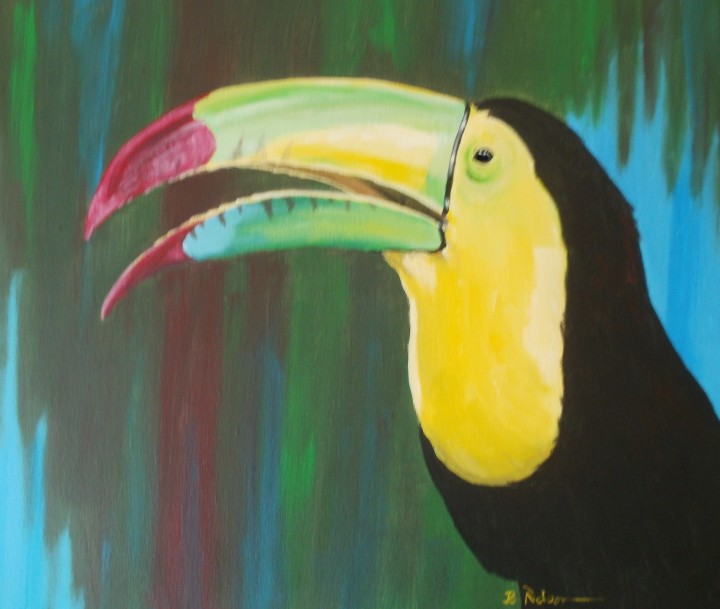
© Art work by Brenda Nelson Keel-billed Toucan

The biggest disadvantage is that toucans really need proper flying space, so they need larger cages (tell that to the people who housed the toucan at the mall department store earlier mentioned). Where as a parrot can sit on top of its cage and play with toys, toucans really thrive when they can stretch their wings and fly.

Toucans are not as common as pets as parrots, even now I seldom see them in pet stores. Of course if you were looking to buy one I would not suggest a pet store anyhow, but would recommend you look for a proper breeder or avian enthusiast.

I hope you have enjoyed learning a little bit about toucans, toucanets, and aracaris.  If you wish to learn more about them as exotic pets please read:  Information on Toucans and Toucanets as Pets

Thursday, June 23, 2011

The Right Cage for a Pet Finch

Finches are small birds often kept as house pets.  Sadly some people make bad mistakes when selecting the cage for their finch. 

Today in the Animal Cabin, we feature an article by Georgina Dawes, who writes about the importance of selecting the right cage for pet finches.

"Whether you are breeding or taking in a bird as your pet, choose a shelter accordingly. There are two cages that you can provide for finches, a regular cage or an aviary.
If you have only one or two finches, then you have the option of using a regular cage but one that is spacious. The smallest that the cage should be is 12x18 inches, and that is recommended for only one finch; but it isn’t suggested that you have only one finch. These are birds that do better in pairs and with each other. They are not interactive with people only with other finches and that makes them happy. That is unless you raise one and take the time to finger train them. The more finches the merrier, but only in even numbers! At times if there is an odd number of finches, two of them will begin to pick on one that is either smaller, weaker or of the opposite gender. They will begin to de-feather them, and at times can kill the odd bird out.

The small cage should obtain everything that an aviary would: feeder, water cup a bath and perches. Make sure that the cage is in a room that is used often, and is at room temperature. Place the cage at eye level so that the finch can see everything that is going on their environment, and make sure that there is a constant air circulation. Finches are very sensitive to temperature and if the room is too hot or too cold they can catch an illness. It isn’t recommended that the cage is outside unless you have an aviary, or the spot where it’s at can be temperature controlled. Any degrees that is over 90 or any weather that is deliberately cold will can be very deadly. Take extra precaution!

art by Mark Gordon Brown


Aviaries are the best choice if you wish to have a group of finches together. Aviaries are very large cages for finches and are similar to the size of a walk in closet. These are most commonly used for breeding birds or for owners who purchase birds often. It’s easier for the finches to breed in these room-sized cages, because they don’t feel as constricted. In one you have more options: you can set up more greenery, more perches, more feeders and baths, and you can separate the birds within the aviary if you’d like. With one of these you are able to walk in to change their food and water. This makes it easier for you and it doesn’t alarm the birds.

In the aviary you can include multiple misters which makes keeping finches outside when it’s warm not as risky to them. If the weather is cold there are always heaters that you can buy for these and most of them come with a protective roof; keeping out rain and other bird feces. It’s essential that these come with a mesh covering, or you attach one to it. There are more insects and small critters that can crawl into the aviary outside of your house. Buy an aviary that fits your needs and your location’s common weather conditions.

Finches can be great pets for a single pet owner or a family. They are effective pets to have in apartments because they don’t make too much of a mess, and aren’t overly loud. Depending on which breed of the finch you purchase, some of them may sing more often than others. The Society finch is one of the breeds where only the male is vocal, and more often when he is mating. If you wish to have an extremely vibrant and colorful bird that sings more often, take a look at the Zebra finch (as in the drawing). Be sure you have time to provide the birds’ basic needs, then you won’t have any problems owning one. Cages, food, temperature, activity and bird interaction are the finches basic needs.

It is important that you know what the finch looks like when they aren’t feeling well. Their feathers tend to fall out, their eyes are droopy and they do not look attentive. It’s best to research or ask your doctor if your finch has odd behavior. It’s better to be safe than sorry! Enjoy the wild and lively birds for what they have to offer, and choose one that fits your personality; it’s not like you have hundreds to choose from!"

Article Source

Read also this article by Mark Gordon Brown, in regards to building a large starplate aviary.  You will need different wire for an aviary for finches, you will note Mark used stucco wire which is fine for large birds, but a finch can easily get through, however the design is excellent where weather allows such aviaries.

Monday, March 14, 2011

Tips for Keeping Pet Chickens

While most people keep chickens to raise for meat, or eggs, some people enjoy keeping chickens as pets.  When keeping pet chickens it is usually hens who are kept, as roosters tend to be loud, and can be mean,  however some people will keep hens and roosters together for the purpose of raising chicks.  In this case the birds are often of the bantam (smaller) variety, which are typically fancy or ornamental breeds.

 Hens start laying eggs around five months of age and do not even need a rooster in order to produce eggs (although they will not hatch).  As she gets older she will lay fewer eggs each year, and many hens stop laying in the winter.

Certain breeds of chickens are friendlier than others, so breed selection when you want a pet is key.  Note that it might seem nice to rescue former battery hens (those used for massive egg production) however these hens have limited human contact and were not bred to be "pets" and as such wont be as relaxed or friendly.

The friendliest chickens tend to be those of quieter breeds that were raised in incubators where they may have been regularly handled.  Chickens are easily befriended by offering them chicken scratch only when you are with them - of course they need proper laying ration at other times - and do best when allowed to free range in the day.  The do need protection at night - in the form of a chicken coop, with roosting areas, and a laying box.

©by Brenda Nelson

For keeping chickens as pets I strongly suggest getting 3 or 4 hens, or if you are getting a rooster and want to raise chicks you may want 1 rooster and two hens.  

Be sure to check the laws in your area to make sure chickens are allowed as pets.

One of my favorite breeds of chicken for pets and for chicks, is the Silkie.  For a friendly hen with good egg production consider a ISA Brown or Red Sussex.  Look for Easter Eggers if you want a mix of colored eggs (even blue).

Cute Pets:  The Silkie Chicken


Thursday, February 10, 2011

Pet Conures

Conures are small, colorful, and playful, parrots.  They are smart and enjoy learning tricks.  There are many different species of Conures in the pet trade, these include:  Green Cheek Conure, Jenday Conure, Nanday Conure, Blue Crowned Conure, and the Sun Conure. 

Nanday Conure ©


Sun Conure ©

Conures tend to be noisy birds (although few learn many words), so may not be a pet suitable for every home. As well they can be nippy in play if not handled correctly, keeping in mind that birds tend to “test” thinks with their beak, if they “test” your finger, and you pull back, they learn this as a game, and can soon become biters.

Conures require large cages, with thicker bars than would be needed for a budgie, or cockatiel. They must have enough time out of the cage to meet their mental requirements.  It should be noted that conures need 10 - 12 hours sleep a night, and prefer to be in the dark for sleeping, so should have their cage covered.

Conures are generally a friendly bird, especially if raised correctly, and many enjoy cuddling in blankets or with toys. However one should be aware that it is best to buy Conure from a reputable bird breeder, not a pet store.

Pet Conures can live up to 25 years, so should be considered as a long term commitment.
Read More:


Wednesday, January 5, 2011

Cute Little Ducks Called Call Ducks

In the world of ducks the Call Ducks are the bantams (small ones). The most common color of Call duck is “gray”, however these birds are not really gray, but rather they have the same coloring as Mallards, being smaller. Indeed these birds were bred to act as decoys to attract Mallards to a pond, or enclosed area, so the hunter could shoot them.

Call ducks weigh about 1.5 pounds, just over half a kilogram, and make terrific pets. They do require a proper enclosure and are often kept in a large pen with a pool for swimming. In most weather they are happy outside, but when nesting prefer to be under a shelter. This should be bedded with straw.


photo source - a White Call Duck

Call ducks can be purchased at bird shows, auctions (at ones that sell pet chickens and other fowl) or from private breeders who may advertise in livestock publications, or at local livestock feed stores. Call ducks can be purchased as mature birds, ducklings, or even hatching eggs.

Here at the Animal Cabin, we have a pair of gray Call Ducks, and they hatched out some ducklings for us.  You can read about them, see their pictures, and Learn more about Call Ducks and their Care - click here.

Discover the Difference between a Duck and a Goose - click here.

Saturday, December 18, 2010

Fluffy Pet Chickens, the Silkie Chicken

Silkie Chickens look more like bunnies than like chickens, but indeed they are birds.  Silkie Chickens (sometimes spelled Silky Chickens) are exotic chickens, as they have blue - black skin, flesh, and bones. Another unusual feature is that silkie chickens have an extra toe on their feet. 

Silkie Chickens are one of the most popular chicken breeds for pets.  They tend to be friendlier than most other chickens and often enjoy being carried around, particularly if handled from a young age.  One of the things that make them so popular as pets is the fact they are friendly, even the roosters are not usually as mean as the roosters of some other breeds. However it should be noted that they are gentle even among other chickens and as such tend to be bullied if in with other breeds. 

Silkie chicken hens are terrific mothers and are noted as being very broody hens - often used to hatch and/or raise chicks from other chickens, or even game birds.


photo source - House Chicken, Sweet Treats, having a day at the Park.

Silkie chickens are soft to the touch, and although their feathers look like fur, they should never be brushed.  Their feathers lack barbicels which lock feathers together neatly.  Although most chickens can fly a bit, silkies are considered completely flightless because their feathers are so poor.  Additionally the loose feathers mean they are less able to cope with cold weather. 
 
Silkie chicks can be purchased from Hatcheries, local farmers, exotic livestock auctions, and bird shows.  Some people enjoy buying "hatching eggs" which are eggs that need to be incubated in order to hatch.  Other people do not want the trouble and buy week old chicks.  Still others prefer to buy more mature birds.

At five months of age the hens start laying light brown eggs, and, like all hens, will lay eggs even without a rooster.  Laying does tend to decrease after two years, but a well cared for pet Silkie can live for more than 8 years.

Our silkie rooster and a chick.


Silkies are small chickens, even their standard size is small, but they also come in a bantam size as well.

When buying Silkie chicks, or chickens, always check to see that the vent area is clean when selecting any bird.  Never buy birds from a farm if you see other sick looking birds around.

Read about what happened to us when one of our hens hatched 9 chicks and one hatched late!


Wednesday, October 6, 2010

Keeping Flying Rats as Pets

Here at the Animal Cabin we know not everyone likes Pigeons.  Many city folk call them "Flying Rats", but there are many people who keep Pigeons in lofts and aviaries.  Breeders have developed some extreme appearances to these birds, some fly in loops, some can not fly well at all, but have beautiful fanned tails.  Pigeons make pretty good pets for somebody who does not want a lot of work, and likes to hear bird sounds in their yard.
To read more about the Fancy Breeds of Pigeons, click here.