Showing posts with label exotic. Show all posts

Sunday, May 4, 2014

Do Animal Shelters Have Exotic Pets For Adoption

If you are looking to adopt an exotic pet you should check your local animal shelter first.  Animal shelters often have exotic pets up for adoption at prices much lower than they would be sold for in pet stores.

An exotic pet is anything other than a cat, dog, fish, or livestock.  In some areas all birds are considered as exotic pets, while in other areas budgies and finches are not "exotic" but parrots and toucans (for example) are.  Either way animal shelters are likely to have exotic pets for adoption, especially in larger cities where exotic pets are more common.

Rabbits, hamsters, and guinea pigs, are the most common exotic pets for a shelter to receive on a regular basis.  Depending on where you live you might also find ferrets, sugar gliders, hedgehogs, chinchillas, pot bellied pigs, as well as lizards and reptiles.

two bunnies, photo by author

Do not expect to find pet wolves or pet tigers for adoption at a local animal shelter, these larger predators usually go to special rescue centers just for those species.

Some animal shelters also deal with livestock.  Many rescue horses and have horses for adoption, or worth with another group who has these other animals for adoption.

One of the benefits of adopting an exotic pet from an animal shelter is that the price is considerably lower than if buying the same pet from a pet store.

Additionally the exotic pets that are at the animal shelter for adoption often come with their cage and supplies if these were brought in by the owner who was surrendering their pet.

If you are looking for an exotic pet check your local animal shelter's website, but note these are not updated regularly so you should really try to call or visit and see what pets they have for adoption.  Petfinder is a good site to use if you are in Canada, the USA, or Mexico and are looking for an exotic pet to adopt but not every animal shelter lists with them.

Sunday, December 16, 2012

Killifish in the Pet Industry

When I was young my father use to get an aquarium magazine and my sister and I use to love looking at the beautiful fish pictures. One aquarium hobbyist magazine always a section devoted to Killifish. There were colorful pictures of fish that we never saw in the aquarium stores; these fish were Killifish.

That was some 30 years ago and I have only rarely seen Killifish for sale in stores since, and even then they were not as spectacular as the ones featured on the pages of the aquarium magazines. Of course I now know that there are different levels of quality among aquarium fish, the most fancy guppies, bettas, and so forth, are never sold in stores, they are sold privately, or often in an auction, this also applies to Killifish. You can also order live Killifish from That Pet Place/That Fish Place. 

 
Only a few varieties of Killifish are sold in stores if you can find them, with most others traded and sold privately. Killifish are sold as eggs or actual fish. They eggs can be shipped dry as certain Killifish lay their eggs before the ponds dry up so the eggs dry out under normal conditions.

Basic Information on Killifish


photo source - Golden lyretail Killifish


Killifish are fresh, and brackish, water fish, with different species found in and/or around most continents of the world excluding Australia, Antarctica, and Northern Europe. Many species are not as colorful as those featured on the pages of magazines, for example the Devil's Hole Pupfish is a Killifish.

Killifish are a type of carp and there are over 1200 different Killifish known, with more possibly yet to be discovered. 

About Keeping Killifish as Pets


As pets, or in the wild, the lifespan of a Killifish can be as short as nine months for some species, to a maximum of three years for some others. The shortest living Killifish often being referred to as “annuals”, these typically being the ones to lay their eggs in a pond that dries up seasonally, and even when kept in an aquarium that does not “dry up” they still do not live longer. 

photo source - Killifish from Nigeria

Each species will have its own dietary needs with some eating mostly algae, others eating other small fish, and many eating mosquito larvae or other insects. 

Most Killifish are under 2 inches (5cm) in length but some can get as long as 6 inches (15 cm). 

Some Killifish can live in a small school if the aquarium is large enough, while other species prefer to live in a small group with only one male.

The water conditions preferred by each Killi species will vary with some living in fresh water and others in brackish water (a mix of fresh and salt water - which can be made using aquarium salt, but not so much as to create a salt water tank). 

Of the species most commonly sold in pet stores, the Golden Wonder (from India), and Flagfish (from Florida), tend to be the best known. Note that in most places it is illegal to catch Killifish in the wild and keep them as pets without a proper permit, nor can you release unwanted pets into the wild.

Discount Aquarium Supplies from ThatFishPlace.com

Live Killifish shipped directly to your door at ThatFishPlace.com


Tuesday, November 13, 2012

Where can you Get Real Veterinarian Advice Online

I have always warned people against getting free veterinarian advice online, you simply do not know who is answering.

On forums and other question and answer sites are loaded with people who may claim to be vets but are not. Sure you might get some help from people based on their experiences but sometimes there is more to it than that, and at any rate a common answer in forums is simply “Take your pet to the vet”.

I have seen terrible advice given out by well meaning people but people who simply do not know the facts. For example I have seen a person ask if they can give aspirin to a cat and they were told “Sure, I gave it to my dog so I do not see why you cannot give it to your cat”. Of course the truth is that aspirin is somewhat risky for dogs (although if carefully dosed it is fine) but very dangerous to cats and even a small amount can be fatal.

PetMD.com is one of the few places where pet owners can turn and find real information from real veterinarians. They have a place where users can ask questions about their pet or other concerns. These questions are answered as quickly as possible by the vets who are online at any given time.

What is really great about the question section for vets on PetMD is that it is not just limited to questions about cats and dogs either. PetMD allows you to ask questions about birds, horses, reptiles, or other exotic pets.


The PetMD website itself has loads of links with information on all different types of pets and is a good resource in itself.  Click on the logo above to give it a shot and ask a veterinarian your pet questions today!

As part of the Pet 360 family PetMD is affiliated with PetFoodDirect.  They also have a symptom checker.


If you have a pet emergency it is best to contact your veterinarian. Most vets do have 24 hour services and are available even when their office is closed. For non-emergency situations or times when you just have a simple question, try asking a veterinarian on PetMD.com

Thursday, April 12, 2012

Links on Exotic Pets and Pet Care

It has been a busy spring which has left me little time for blogging.  We had 18 lambs and a couple need bottle feeding so that is time consuming.  Rather than writing a full article about one specific pet, I am just going to provide you with some short information on several exotic pets with links to further reading on each.

Rabbits


Rabbits are very popular as pets, there are many breeds of rabbits, some of which require more care in regards to their fur.  Rabbits are often kept as outdoor pets however if their rump becomes dirty they are at risk from fly strike, a condition in which flies lay eggs on the rabbit's rump and the maggots can kill the rabbit.  Rabbits should have at least 2 hours out of their cage every day.

Read more about Rabbits.

Ferrets

$5.99 Flat Shipping on orders over $69.99

Ferrets are possibly more work that rabbits in that they are very intelligent, curious, and playful.  A ferret should be out of its cage for at least 4 hours a day.  Ferrets are carnivores and will try to kill other small house pets, such as rabbits, birds, or even kittens. 

Read more about Ferrets.

Hedgehogs


Hedgehogs are nocturnal pets so may not be suited for everyone, as they can make a lot of noise at night.  Hedgehogs should be taken out for at least 2 hours every evening, usually starting around 8:00 pm.  Care should be taken when buying a hedgehog food as many low quality hedgehog foods do not meet their needs for meat.

Read more about Hedgehogs.


Skunks


Skunks are not a common exotic pet but they are certainly one of the most unique.  Skunks are carnivores and are nocturnal so they are not a suitable pet for everyone.  In some areas descenting skunks is illegal even though they may legally be kept as pets.  Once they are tame they are not likely to spray.

Read more about Feeding Pet Skunks.

Insects


For some people furry pets are no good, they cause allergies and are more demanding than a smaller pet such as an insect.  There are many types of insects that can be kept as pets, however in most areas it is illegal to catch and keep wild insects for more than 24 hours, however the pet trade does sell some insects as pets, such as mantis, beetles, and walking stick insects.

Read more about Walking Stick Insects.

Toucans


Toucans are considered to be soft billed birds, this is not in reference to the bill, but rather to what these birds eat, they eat soft foods, not things like nuts.  Their mouth is not as strong as a parrot's.  As such they are a more gentle pet.  Similar, but smaller, are Toucanets.

Read more about Toucans and Toucanets.

Buying Exotic Pets


Remember exotic pets are not for everyone, be sure to buy from a reputable breeder and do your research first to make sure you pick the right kind of exotic pet for your lifestyle.  Never buy a pet that you cannot provide lifetime care for.

Read a Guide to Buying Exotic Pets.

Also remember many animal shelters have exotic pets up for adoption, always check there first.

Tuesday, February 21, 2012

Peruvian Pasos, Exotic Horses


For as long as I can remember I have been a horse crazy girl. Neither of my parents were horse people so it was rather hard to convince them to buy me a horse, however I did manage to convince them to get me riding lessons. The riding lessons were your typical English riding lessons, done in groups on lesson horses.


One year the stable, which was in Edmonton, hosted a showcase of different horse breeds. One of the breeds that attended were Peruvian Pasos. While horses are not really “exotic pets” the Peruvian Paso certainly qualifies as an exotic type of horse.

The Peruvian Paso not only looks exotic but has two very unique gaits for which it was bred. These gaits are the Paso Llano and the Sobreando. Both are four beat lateral gaits, left hind, left front, right hind, right front. The Sobreando is slightly faster with a pause between the second and third step.

At the showcase of the breeds there were a few Peruvians, the one I remember best (this was almost 30 years ago) was a Palomino named Gato del Sol, cat of the sun. I remember him because I actually got to ride him. As part of the breed showcase people were allowed to ride some of the horses. I rode him (this being only for a few minutes) but wow I can honestly say he was smooth like silk. He also had a beautiful thick mane and tail; characteristics of the breed. They do not even cut a bridal path.


photo source - The gaits of the Peruvian Paso are natural and foals perform them from a young age, it almost looks like a trot here, but is not.

All in all these are very showy, beautiful, horses which, I think, qualifies them as exotic!

Peruvian Pasos are fairly rare, with less than 30,000 worldwide. Peruvian Paso horses originated in Peru but there are several breeders in the States and Canada (at least two breeders right here in Alberta). Some breeders have been criticized for trying to change the breed. Horses should stand between 14.1 and 15.2 hands but some people want to make them taller, others try to make them faster and have altered the gait too much in the opinion of other purist breeders. If you are looking for a Peruvian Paso try to familiarize yourself with the breed and only buy from a breeder who is sticking with correct breed standard.

To see more pictures and learn more about the Peruvian Paso, Read Here.

If you are a kid and want to try to convince your parents to buy you a horse (good luck) you can Read Here.

Saturday, February 11, 2012

A Basic Introduction to Toucans, Toucanets and Aracaris

When I was young, growing up in Edmonton, Alberta, I remember often visiting Meadowlark Mall, yes it was a thriving mall in those days, before West Edmonton Mall was developed. Anyhow, there was a department store in the mall, Zellers, and in the back left corner was their pet section. For the longest time I remember they had a Toucan for sale.

The toucan sat in a small cage, not much bigger than the cages we now see finches in. It was a beautiful bird. This was almost 40 years ago. I do not know if that bird ever sold, or what became of it. At some time Zellers stopped selling pets (yeah!), and eventually the mall itself changed. Today I was reminded of that bird when answering a question on WebAnswers about Toucans.

As Toucans, and their smaller relatives, the Toucanets, are favorite birds of my husband I was inspired to write about them and learn more about them than I had in the past.

©Art work by my husband, Mark Gordon Brown - Emerald Toucanet.


Toucans, toucanets, and a smaller relative the aracaris, are softbills, birds that use their bills for eating soft fruit and berries. They will also eat insects, small lizards, and in the wild have been know to eat eggs and baby birds of other species.  The term "soft-bill" refers to their diet of soft foods.

As pets they have some advantages over parrots although they may be considerably harder to find in stores.

Toucans are generally quieter than parrots.

Toucans do not have the ability to bite as hard as a parrot.

Because they eat fruit and berries, toucans are less messy than parrots who eat nuts and seeds.

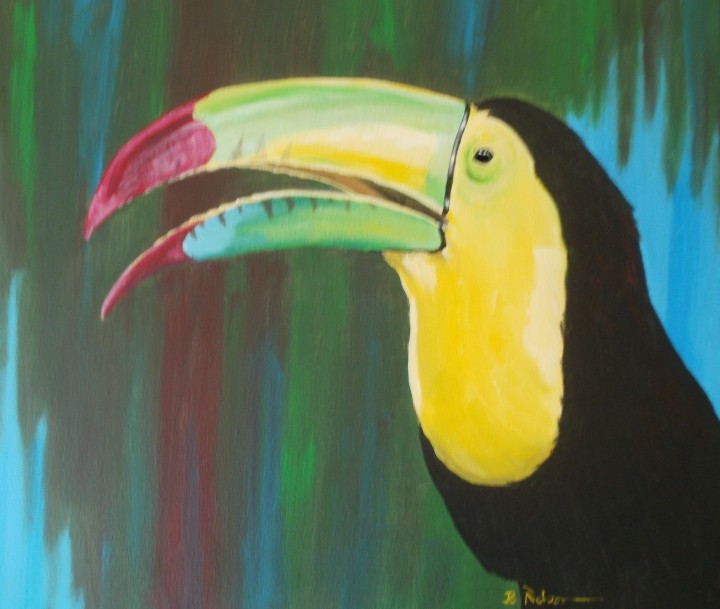
© Art work by Brenda Nelson Keel-billed Toucan

The biggest disadvantage is that toucans really need proper flying space, so they need larger cages (tell that to the people who housed the toucan at the mall department store earlier mentioned). Where as a parrot can sit on top of its cage and play with toys, toucans really thrive when they can stretch their wings and fly.

Toucans are not as common as pets as parrots, even now I seldom see them in pet stores. Of course if you were looking to buy one I would not suggest a pet store anyhow, but would recommend you look for a proper breeder or avian enthusiast.

I hope you have enjoyed learning a little bit about toucans, toucanets, and aracaris.  If you wish to learn more about them as exotic pets please read:  Information on Toucans and Toucanets as Pets

Saturday, December 24, 2011

How to Feed a Pet Skunk


If you own a pet skunk, or are thinking about getting a pet skunk you will hear a lot of conflicting information in regards to feeding.  This is in part because very few studies have been done on skunk nutrition, and as well because all food companies that make skunk food (there are only a few) will tell you that their food is the "best".  

In the past a lot of skunk owners have fed cat food or ferret food to their skunk, but both are too fatty and contain too much protein. Skunks fed these diets often became obese.  Many skunk owners now consider feeding a top quality, grain free, dog food to be better (do not contain BHA, BHT, by-products, corn gluten meal, or brewers rice).  However the concern is that the skunk still requires taurine - an ingredient not found in dog food.

Skunk owners can purchase taurine in powder, liquid, or tablets. Taurine should be feed at 200 mg per day. Calcium supplements are also a good idea.  Both can be purchased at a health food store (some pet stores may carry these too).

A skunk's diet should be roughly 65 % meat and dairy products, 30% vegetables, and 5% fruit.

Vegetables can be fresh or frozen (and thawed), canned vegetables tend to be lower in nutritional value.  Skunks should not have asparagus, onions, or iceberg lettuce.

Fruits is safe for skunks except for grapes and avocados. Fruit should be given only two or three times a week, not daily.

Skunks can eat nuts, excluding salted nuts, almonds offer a good source of Vitamin E.

Pet skunks can eat eggs (boiled – shell and all), and most dairy products (including goats milk) except whole milk, cream, and high fat cheeses. You should not feed your skunk yogurt with artificial sweeteners (aspartame), which are often found in low-fat yogurts.

Skunk owners can also purchase crickets, mealworms from pet supply stores. Live crickets may escape so most owners prefer to buy dried crickets.  You can dig up worms for your skunk, but most people prefer to leave the worms in the garden where they are beneficial.

Skunks under 4 months of age should be fed 3-5 small meals a day, do not feed a skunk free choice, it will eat too much and become obese. Adult skunks can have 3 meals a day.  For many skunk owners this means feeding early in the evening, later at night, early in the morning.  Watch to see how much your skunk can eat in 20 minutes time, and remove uneaten food after that.  Monitor your skunk for weight loss or gain and overall signs of eating right.

Skunks are natural foragers, if you leave any food out they will find it, and can open cupboard doors while searching for food.  Keep chocolate of of a skunk's reach it is toxic.

Skunks should have their food and water in stainless steel or ceramic bowls that are built so they do not tip or spill.


Indications of a Skunk with a Diet Problem:

A fat skunk is not a healthy skunk.  You can reduce the amount of food you feed in the winter as they naturally would find less to eat in the winter and this will help reduce the skunk's weight.

A skunk that is skinny and drags its hind legs could be suffering from a lack of calcium.

Hair loss, particularly on the back and tail, indicate an improper diet (or mites).

A skunk with vision problems may be suffering from a lack of taurine.

If a skunk's white fur looks yellow this may be a sign of poor care, or a poor diet.

Further Reading on Feeding and Care for Skunks

Thursday, December 8, 2011

Bobcats as Exotic Pets

Many people are looking for more exotic, more unusual, slightly more dangerous, exotic pets; but they still want cute!  As such bobcats and lynxes are now being considered as pets and are slowly entering the exotic pet market.

I personally do not feel a need to own such a creature but did a lot of research on ownership of them which I present to you now. 

In most areas you will require a licence or permit own own a pet bobcat or pet lynx.  Depending on your area this may require getting your property inspected for security.  Your local zoning may be an issue too.  You can only acquire these exotics from licenced breeders who are required to check your permit before selling to you.  Note that you cannot catch and keep a wild bobcat or lynx in most areas as this is illegal, not to mention cruel and dangerous.


Bobcats are about twice the size of a domestic cat, and the Canadian lynx is slightly larger, so you must be sure you can accomodate such a big animal, offering it enough room to play, and as well you must consider the higher costs of feeding and over all care.

Some people breed their own rabbits for the purpose of feeding their pet bobcat or lynx, others use premium commercial diets.  Meat must be the main part of the diet as, like all cats, bobcats are true carnivores. 

You need to be certain you have a veterinarian willing to treat and care for such an exotic pet. 

Keep in mind that a bobcat or lynx is very playful, they will be more destructive than a regular house cat and require plenty of things to climb on.  They may also see any smaller pets as prey.  Like most cats they spend the majority of their day sleeping, but like to be awake in the morning and evening.

If you are intersted in getting a pet bobcat or pet lynx the first thing to check is what licensing and/or permits are needed in your area.  Contact a breeder to see what their requirements are in terms of space and fencing, as most breeders insist on doing home checks before selling to a buyer - they may require a deposit made before they actually have kittens ready to sell.

You should plan on spending $1200 - $1800 USD to purchase a pet bobcat.  Make sure it has been vet checked and vaccinated first.  It should be no younger than 8 weeks of age and should come with health guarantees.

Friday, November 11, 2011

Pet Spiders

Todays' article is on Keeping Pet Spiders, by Jerry Lee Hall

Spiders' Increasing Popularity As Exotic Pets
Spiders can be really be amusing to observe. They move about quietly and are known to cope well in several types of environments. Maintenance is likewise not very difficult as they are generally clean and don't leave much clutter. These reasons account for the growing popularity of keeping spiders as exotic pets.

However, as spiders are generally seen as low-maintenance pets, owners at times fail to recognize that taking care of them is, in fact, not that straightforward. There are still many things to take into consideration. Thus, having spiders as pets as a result of mere influence of their popularity shouldn't be the case. You must also remember that, just like in taking care of other types of pets, a high level of responsibility is involved.

If you are a first-time owner, it would be wise to choose those which are neither fragile nor treacherous. Tarantulas like Chilean rose, Mexican Redleg, and Costa Rican Zebra are well suited to being pets. Their venom isn't very harmful but is instead similar to that of the bees.

Strength of venom is one of the important things that you have to check at the very start of your search for an exotic pet spider. Mild venom may cause significant pain. Hairs on their abdomen are equally harmful as they may shed it in moments of threat and stress and may cause irritation and great hazard when they get into the eyes. You have several options but, in general, prior to acquiring any type, you have to check with your local government if there are policies regulating such.

To maintain a spider's suitability to become pets, you have to create a habitat that closely mimics their natural living environment. This need not be expensive, or spacious, as a simple terrarium may be enough. You also don't have to worry about giving spiders companions of the same species as they are usually not after socialization. By nature, they are also predatory thus they may just end up eating their companion even if it is a fellow spider. What you have to check is the enclosure as spiders are good climbers and they can easily pass through small holes or crevices. They may escape if their habitat isn't secure enough.

Taking care of spiders indeed isn't that easy. They deserve respect just like any other animal. At the same time, you also have to protect yourself from possible harm that they may inflict. Overall, acquisition must be a result of careful research and consideration.

The Animal Cabin would like to add:
As with buying any pet be sure to buy from a reputable breeder.  Spiders are sometimes sold in pet stores but also are often sold at reptile and herp shows and sales.  Reputable pet spider breeders often advertise in reptile and amphibian shows.
Make sure you are instructed on how to feed your new pet spider as well as how to handle it carefully, dropping a spider can kill it.

Saturday, October 22, 2011

What does a Weasel Look Like?

Have you seen the television commercial where a little girl asks her iPhone "What does a weasel look like?"?  Let's find out more about what weasels are and what they look like.

Although there are 17 types of weasel the one most of us are familiar with is the ferret.  Ferrets are a pretty good example of what all weasels look like, some other weasels may be a bit larger, some may be a bit smaller, but in general all weasels have the same body shape and structure as we see in the ferret.  Weasels are long animals with short legs and a fairly pointed head.  They are carnivores, meat eaters with sharp teeth.


Black Footed Ferret
Some species of weasels have been used for fur, and for hunting, some species (the domestic ferret and polecat) have been kept as pets.  In fact the domestic ferret has been kept for over 2500 years and was commonly used to chase (to "ferret) rabbits, and other vermin, out of their warrens. 

domestic ferret in a playful war dance
Weasels come in different sizes from 5 inches long (12 cm) to 18 inches long (45 cm), with additionally long tails. Their bodies are very streamlined and thin. They have small rounded ears, and pointed noses.   Many weasels are brown in the summer, with a white stomach, and moult to become white in the winter.

If you are considering getting a ferret or polecat as a pet, be warned, they are playful and active.  Ferrets need lots of attention, and if you have other pets, such as rabbits or birds, the weasel's natural prey drive may result in a disaster  Pet ferrets need at least 2 hours out of their cage every morning, and another 2 hours every evening.  As carnivores ferrets need to be feed a food with a high meat content. They can have fruits and vegetables as treats or snacks but only in small amounts. Be sure you have a veterinarian that is familiar with them as well.  Female ferrets must be spayed unless they are to be kept and used for breeding.

Sunday, May 29, 2011

Cheetahs as Exotic Pets

Recently in the United Arab Emerates there have been some stories of Cheetahs suffering as exotic pets.  These tales should serve as a warning for anyone considering getting such a wild cat for a pet.

In the UAE, Cheetahs, and other exotic pets, are often kept on the rooftops of buildings, often on chains.  In a recent story which made news May 29, 2011, a Cheetah cub, about seven months old, was found wandering the streets with an injured front paw.  The Al Rahma Animal Welfare and Resuce Society speculates that the big cat's paw was injured in a fall, or jump, from its roof top home.  Additionally it had a metal chain around its neck.  Very likely the cat had been on a chain, which may have broken, or been cut, when the animal fell, or broke some other way.

At any rate the cheetah cub was found in the Karama district of Abu Dhabi, and later sent to a wildlife rescue place.

This cheetah was not the first exotic pet, or big cat, to make news in the area, sadly it is only one of many, including cases where smugglers have been caught with kittens, and and even worse recent case where officials saved two lions from a home where both were suffering in horrid condition as the result of neglect, and abuse.  Both lions had been declawed, as well their teeth had been filed down and had become infected.

Read More on the Cheetah's Rescue and see a Picture.
Al Rahma Animal Rescue in Abu Dhabi - Facebook Page

Over all if you are thinking that a big cat is a good pet... think again.  These cats require a lot of meat, they need a lot of space, and they are dangerous.  Even if well handled they have a potential to harm, as well the human lifestyle is not at all natural for such an animal.  Cheetahs, need to run, they were made to stretch their limbs and run.  They are not status symbols.  A far more suitable pet would be a greyhound, or Bengal Cat.

Tuesday, April 19, 2011

Innisfail Odd and Unusual Animal and Bird Auction

If you are in Alberta and looking for an odd or unusual exotic pet, the Innisfail Odd and Unusual Animal and Bird Auction is not to be missed.  This is a three day event that happens twice a year, Easter weekend, and Thanksgiving weekend.

As seen at the Innisfail Auction
The Easter sale will begin on Good Friday, with goats and sheep selling in the day.  Later in the evening Aniques, Collectables, and most caged pets will sell (sometimes including some caged birds), this is often hedgehogs, sugar gliders, guinea pigs, and a few reptiles, but can be animals such as wallabies.  Many exotic pets sell at this time - different every auction!

On Saturday, the other birds will sell, these being exotic chickens, pheasants, peafowl, emus, and who-knows-what!  Rabbits will also sell on Saturday.  Many caged birds also sell on Saturday.

On Easter Sunday, the miniature horses, exotic cattle, llamas, and other large mammals (bison, elk) will sell. 

The Thanksgiving weekend sales run the same way, Friday to Sunday.

Pheasant we purchased at the Innisfail auction.

Anything is possible - it all depends what sellers bring.  I have attended many of these sales, we have seen many exotic pets and animals at this sale, every thing from tiny baby snakes, to a halter trained bison.  We  have seen rare breeds of livestock, and a few regular ones!


Zebu seen at the Innisfail Auction
Some exotic pets that are auctioned off require special permits to own, (such as migratory birds, or primates) so make sure you bring your permits if you plan on buying certain exotics.  Come early to have a look around, get your bidder number, and find a seat.  If you are selling - come even earlier!


Innisfail is just south of Red Deer, Alberta, on highway 2, about an hour north of Calgary.  The auction market is just off the highway at the south end of town. 

To see Other Sales Dates - click here.

Further Reading

Buying and Selling at Exotic Animal Auctions
Starting a Petting Zoo
How to get a Better Price for your Horse, when Selling at Auction

Saturday, April 9, 2011

The Exotic Pet Trade and Wildlife Trafficking

When buying an exotic pet it is very important that you buy from a reputable breeder. Unfortunately many people simply want an exotic pet and do not check where it came from. In some cases exotic pets are obtained illegally and smuggled into areas where they are offered for sale.

Buying pets that were caught in the wild is never a good idea for the following reasons:

Disease - Wild caught animals could be riddled with disease, even if they appear healthy they could be carrying a disease which could risk their health, or spread to other pets.
Parasites – It is just as likely that a wild caught animal would be full of parasites. These might not even be a problem when the animal is living naturally, but when introduced to the stress of capture and confinement the parasites can easily take over.
Stress – Stress in itself is a huge health risk to an animal. The stress of being captured is enough to kill some animals, as well it lowers their immunity, as does the stress of being confined. Stressed animals do not thrive, many die either from the stress itself, or from not being able to eat as the result of being stressed.
Removal from Natural Breeding Population – In some areas certain exotic animals are at risk, when healthy breeding animals are removed it lowers the genetic pool and the population's ability to sustain itself in a healthy manner.
Habitat Destruction – In some cases habitats are destroyed intentionally to collect certain animals. One of the most common examples of this is pouring cyanide on a coral reef. Many fish, and corals die, while only a few are knocked out and collected to be sold to pet stores.
Poorly Cared For – Animals that are caught wild for the purpose of resale are generally not properly cared for by their captor, other than with the interest of getting them to the store, or point of sale, quickly. Some animals, such as snakes, can go for a while without eating, but need to be kept warm, and this lack of care often leads to some dying before making it to the point of sale, or leaving them stressed when they are resold.

You want a healthy pet, one that came from somebody who knows what they are doing, not from somebody who captured it for profit.  Sadly many people who want exotic pets unknowingly support the cruel industry of wildlife trafficking.


Never Support Unknown Sources– Overall when you buy from anyone that is not a breeder you truly do not know the animals origins. If you buy from a pet store and the pet store bought from a broker, and the broker bought from a wildlife smuggler, you have just supported the wildlife smuggling industry.

A breeder will know more information about the real care needed for such animals, and will provide you with genuine help.

The only other way of being sure your exotic pet purchase does not support illegal wildlife smuggling is by adopting your exotic pet from a pet rescue. The rescues do not make any money, and simply want the pets to get a good home. The people they get the pets from also did not profit when they gave their pet to the shelter – so adopting a pet from an animal shelter does not contribute to illegal animal trafficking.

Further Reading

Snakes on a Bus - hundreds of illegally caught snakes, 186 endangered tortoises, 40 lizards, and an armidillo.

Friday, March 4, 2011

Adopt the Internet Day

Petfinder.com is using March 15, 2011 as Adopt the Internet Day, a day they plan to "take over" the Internet in an awareness campaign about pet adoption and issues facing homeless pets. 

Petfinder.com is a place where prospective pet adopters can go to find shelters with certain animals for adoption.  They list adoptable cats, dogs, horses, birds, rabbits, reptiles, and even farm animals.  Thus they may even have the exotic pet you are looking for!


On March 15 Petfinder.com is encouraging people to change their Facebook profile picture to one of an adoptable pet.  They ask people to tweet about an adoptable pet, specifically using the hashtag #adopttheinternt.

Until March 15, 2011, pet lovers can visit ICanHasCheeseburger and create a caption for an adoptable pet.

Please support Adopt the Internet Day, and make plans visit Petfinder.com's Special Page, on March 15.  Be sure to tell people about pet adoption on March 15 and encourage them to use Petfinder to locate a shelter near them.

Read How to Adopt a Pet from an Animal Shelter
Read Petfinder Making News

Thursday, February 10, 2011

Pet Conures

Conures are small, colorful, and playful, parrots.  They are smart and enjoy learning tricks.  There are many different species of Conures in the pet trade, these include:  Green Cheek Conure, Jenday Conure, Nanday Conure, Blue Crowned Conure, and the Sun Conure. 

Nanday Conure ©


Sun Conure ©

Conures tend to be noisy birds (although few learn many words), so may not be a pet suitable for every home. As well they can be nippy in play if not handled correctly, keeping in mind that birds tend to “test” thinks with their beak, if they “test” your finger, and you pull back, they learn this as a game, and can soon become biters.

Conures require large cages, with thicker bars than would be needed for a budgie, or cockatiel. They must have enough time out of the cage to meet their mental requirements.  It should be noted that conures need 10 - 12 hours sleep a night, and prefer to be in the dark for sleeping, so should have their cage covered.

Conures are generally a friendly bird, especially if raised correctly, and many enjoy cuddling in blankets or with toys. However one should be aware that it is best to buy Conure from a reputable bird breeder, not a pet store.

Pet Conures can live up to 25 years, so should be considered as a long term commitment.
Read More:


Saturday, January 29, 2011

Owning a Pet Wolf

People often say they want a pet wolf. These beautiful, wild, canines, are the ancestors of all domestic dogs, and as such people often think owing them is an ideal. Who wouldn't want to own such an iconic animal? Who wouldn't want the attention of their peers as they walk down the street having dominion over such a creature as a wolf?

Well.. me for one.

The domestication of the wolf into the pet dog we see today, was not simply brought about by primitive people owing wild wolves. Undoubtedly they only kept the tamest animals and would have gotten rid of (or maybe even eaten) those with unsafe tendencies. It took generations before the wild wolf became a “pet dog”.  Not just any wolf was kept, only the smaller ones, the less aggressive ones, that were timid towards the other "wild" wolves were the ones that bonded with the people of the time. 

One of the closest domestic dogs to a wolf, is the Husky. Not everyone is suited to owning a Husky, these dogs are noted for being somewhat aloof, prone to jumping fences and running away, and can be a problem with cats, and livestock. Huskies need mile long (or more) runs every day. If a person is aware that they would not be a good owner for a Husky, they certainly would not be cut out to own a wolf, even where ownership is legal (it often requires a permit, and special fencing).

Wolf- Hybrids are wolves crossed with domestic dogs.  One must be careful when getting such a pet; a wolf hybrid will also require extra care, and lots of exercise and may have a high prey drive.  Also some sellers are not ethical, without proof that an animal is part wolf, it could be anything, even a poorly bred Husky!

In general ownership of an actual wolf is not for a person with little experience, they can be more demanding than a typical pet dog, and have more concerns in regards to physical needs.


Saturday, January 22, 2011

Pet Fennec Foxes

Fennec Foxes are not at all like "Domestic Dogs".  Foxes are actually from a slightly different genetic line than domestic dogs, who are descended from wolves.  Fennec Foxes are more suited for a person who likes cats, than a person who wants a typical dog as a pet.

Photo from Wikimedia Commons
Keeping Fennec Foxes as pets often falls under different laws than keeping regular dogs.  Many places have banned these cute pets, they are currently not allowed as pets here in Alberta, where I am.

In some areas Fennec Foxes may be allowed as exotic pets with special permits. This something a person must learn before they get one as a pet.


The behavior of a Fennec Fox is somewhat cat like, they are clever, and playful, and enjoy exploring things.  They are mostly nocturnal, which can be a problem in some homes.  They will try to hunt during the night, much like a pet cat would.  Like all Foxes, they have a high prey drive and may bother smaller house pets.


Fennec Foxes should only be purchased from reputable breeders, never from pet stores.  Some animal shelters may adopt them out, however this is very uncommon.  Fennec Foxes are also sometimes sold at exotic pet shows and sales. 

Before getting a Fennec Fox as a pet, be sure they are allowed in your area and that you have a veterinarian willing to treat Fennec Foxes (and experienced).  As well more research should be done into the care of a Fennec Fox to be sure they fit your lifestyle.

Read More on Fennec Foxes as Pets

Sunday, January 16, 2011

Why Are Exotic Pets Banned in Some Areas

One struggle prospective exotic pet owners face is that the animal they may wish to keep is banned from where they live.

There are many reasons for this, depending on the animal, and the area, and the law makers.

When my husband asked why Fennec Foxes could not be kept as pets here in Alberta, he was told by somebody at the Fish and Wildlife department that it had something to do with a stripper having a tiger at a bar and people petitioned for a blanket type law against all exotic pets.  Over time a few exotic pets (such as wallabies) have been allowed, and people have been able to apply for zoo permits to own other certain exotic pets.  This may, or may not, be the real story, but this is what we were told by somebody who should know.
©Brenda Nelson

It is easy to understand why some areas would not allow dangerous exotic pets, but what about the seemingly harmless exotic pets, ferrets, hedgehogs, chickens?

Many exotic pets are not allowed due to the risk of them escaping and destroying native species, or due to the considers of them spreading disease to native species, or the risk they pose to humans.  In most areas keeping animals that are native to the area is not allowed as it is hard to determine if an animal has been legally bred - or illegally snatched from the wild. 

The livestock industry has been held to blame for protesting against allowing city people from keeping pet chickens.  Indeed if people could raise their own eggs, a whole industry would suffer.  This is a pity, since pet hens would have better lives than battery hens, and some chicken breeds make terrific pets!


In some areas it is simply too hard to enforce proper care of certain animals, so it is easier for law makers to ban the animal all together.

The public holds a large role in creating bans for exotic pets.  Public outcry is even held to blame for bans on certain breeds of dogs.

If you are in an area where a certain exotic pet is banned, you will have to apply for a special permit, lobby to have the laws changed, or move.  Keeping a pet where one is not allowed, not only puts you at risk for getting a fine, but the animal may be removed and euthanized immediately according to the laws in your area.

Are you Ready to Own an Exotic Pet?  Click here to find out!
Read about Concerns when Keeping a Pet Illegally.

This does give me the idea for writing something in regards to How to Lobby Against Exotic Pet Bans in Your Area.

Monday, December 6, 2010

Pets that Bounce - Wallabies

Who among us as children did not want a pet wolf, tiger, or wallaby?  Okay perhaps Wallabies were not everyones first choice for a pet, but for some Wallabies are the most desired pets. 

Of course they are not legal everywhere and do have very specialized care and needs that people must be aware of.  There are several Wallaby breeders near me (in Alberta, Canada), and a few people own them as exotic pets. 

One of the biggest cautions is for cat or dog owners.  Wallabies should not be in contact with either of these animals as there are some health problems that can transfer through cat, or dog, feces, and be deadly to Wallabies - Coccidia being of major concern, and much harder to treat or prevent in Wallabies than in pet cats and dogs.

Also be aware there are several breeds of Wallaby, some being better for pets, some being more hardy in cold climates.  One should do more research before rushing out to get an exotic pet Wallaby.
Read more about buying, and keeping, an exotic pet Wallaby, click here.

Wednesday, November 24, 2010

Exotic Pet Skunks

Here at the cabin we have a couple of barn cats that live outdoors (they have a dog house for shelter and several barns - both cats are neutered of course and brought into the house when its very cold, althogh they prefer to be outside).  We leave bowls of cat food out for them, including one bowl on the deck.  Sometimes this food seems to vanish overnight.   We have seen who is stealing the food on a couple of occasions.  A skunk!  This cute skunk is easy to chase off and has never sprayed us or the cats. 

Above you see he/she spilled the big container of cat food.  The crash alerted me.

In our area skunks are not allowed as pets although this one seems to think we are in charge of feeding it!  Some people do keep skunks as pets, they can be very ferret like in behavior with the main concern in that pet skunks (and all skunks) are nocturnal.  As well an exotic pet, like a skunk, should never be caught wild (in most cases this is illegal) rather they should be purchased from a breeder, or adopted from a rescue group. 

Read more about the Care for Pet Skunks - click here.
Read more about Skunks in General - click here.