Showing posts with label animals. Show all posts

Friday, December 14, 2012

Share Your Pet Pictures on Your Own Custom Calendar

I remember several years ago my aunt surprised us with a calendar she had made using pictures of her cat, dog, and kids. It was very unique. She did it really well too using pictures she had taken throughout the year and matching them up with the appropriate month. 

I realize that it is a little late in the year, but I only got to thinking about this just now after finding Calendars.com.  They also have a huge assortment of dog breed specific calendars for all the dog lovers out there as well as a full range of pets and animal calendars.  Some of their wildlife calendars (such as the Hummingbird WWF 2013 Deluxe Wall Calendar) have a special bonus - in that part of your purchase price goes to WWF as a donation to help them help more wild animals!

You can make your own custom calendar at Calendars.com and if you are talented enough, and have time, you can stage a few pictures now to use throughout the calendar, such as having your pet sit with a red rose by its feet and a red background to use for February (Valentines Day). 

Their prices are great too, and if a personalized calendar is not for you they have a huge range of other calendars (as mentioned) books and puzzles with animal themes.

click here to go to the site

If you are looking for a unique gift or just something unique for yourself then for sure consider making your own custom calendar. I wish I had remembered to make this suggestion earlier, but there is still a little time before the New Year. A calendar is something pretty much everyone enjoys getting and when finished with the year they still have frameable pictures they can keep if they wish.

Like them on Facebook and get 10% off (a window should pop up after you have been on the site and picked out a calendar).

Friday, September 7, 2012

White Tigers, Cruel Man Made Mutants

Did you know that there are no wild white tigers?  Although zoos often refer to white tigers as Royal White Bengal Tigers, this is not actually a species of tiger.  The white tigers you see on display in zoos today are not even purebreds, they are crosses between Siberian Tigers and Bengal Tigers.  They are also greatly inbred, the gene for white is recessive so white tigers are often created by breeding father to daughter, mother to son, and brother to sister. 

As with most inbred animals there are always more genetic health problems.  The gene that makes them white is linked to eye problems.  White tigers always have poor vision, making them more dependent on their handler.  In some cases this is easy to see as they may be cross eyed, in other cases the problem is in regards to how their eyes are wired to their brain.   Some tiger trainers prefer white tigers because their poor vision makes them easier to train, they are more dependent on their handler than a tiger with normal health vision.

photo source

White tigers are often born with spinal deformities, cleft pallets (a mouth deformity), and organ problems.  It is not uncommon for them to die shortly after birth.

Although not all zoos in the United States are members of the American Zoological Association (AZA), this group passed a ban in 2011 prohibiting members from breeding white tigers.

Although I realize many of you might want to see these beautiful animals it is best to not support the zoos that have white tigers.  There is no ethical reason for breeding them.  In fact many of the people who try to breed white tigers "dispose" of the tiger cubs born with normal orange colored fur.  The only reason they breed white tigers is for greed, vanity, and profit.  It must be stopped.

If you see white tigers in your local zoo be sure to express your displeasure with the intentional breeding programs that some zoos have adopted to make more of these sickly animals.

Further Reading on White Tigers

Big Cat Rescue - White Tigers


Tuesday, September 4, 2012

Released Pet Turtles Living in Stanley Park

Red-Eared Slider Turtles are native to the southern United States, so what are they doing in a pond in Canada?  On a recent trip to Vancouver, we saw several of these turtles swimming and resting on rocks and logs in Vancouver's Stanley Park.  Although they looked quite at home in the Lost Lagoon, they did not belong there.

Red-eared sliders got their name because of the red marking behind their eyes (which can also  be yellow), and the fact that when scared they just “slide” off the rock or log and disappear into the water.

When we were at the Lost Lagoon we saw several, if we had a better camera we could have taken a picture of at several turtles piled up on a log together, but as it happened we were still able to get a few pictures of the turtles closer up. As cold blooded animals, reptiles need to rest in the sun to get warm and to digest their food.

Red-eared slider turtles need water to eat, and are omnivores, often eating more meat as youngsters, and more plant matter as adults.


Red-eared slider turtles are sometimes kept as pets, but it is illegal to catch one in the park and take it home, as it is also against the law to release an unwanted pet turtle into the park. They are considered an invasive species and should never be released anywhere into the wild.  Again these turtles are not native to the area, or Canada in general, so the only reason they are in the Lost Lagoon in Vancouver's Stanley Park is because at one point they would have been introduced, either by pet owners who discarded unwanted animals in the park, or having somehow escaped from captivity.

Discount Reptile Supplies at www.thatpetplace.com

Female red-eared slider turtles grow slightly larger than males, reaching just over one foot in length (30 cm). They can live up to 30 years, a major consideration for anyone thinking of getting one as a pet.

Although often seen for sale it is illegal in the United States to sell a turtle with a shell under 4 inches in length.  If you see somebody with turtles of this size for sale please report them, as most will not survive and we should try to stop people from putting the lives of animals at risk just to make a few dollars.

Sunday, July 22, 2012

Feeding Wildlife in Stanley Park, the Raccoons


We recently took a holiday to Vancouver, Canada. Our hotel was within walking distance of Stanley Park, a 1,000 acre park, surrounded nearly all the way by ocean. On our first night we walked to the Aquarium, and on the way we saw a family of raccoons, a mother and her two youngsters, raiding a garbage can.

The following day we walked around Stanley Park and sure enough we encountered more raccoons, including another mother with three youngsters and an adult who was missing a tail. There was a man feeding them what appeared to be fried chicken. A short time later a woman arrived to feed them grapes and cat food. Other people fed them cookies. 

To note, I am aware that grapes can be toxic to dogs, but not sure how they affect raccoons.

We spoke to many of the people who were feeding the raccoons and many said they made daily trips to feed the raccoons and other animals in the park. The people said that the park's people did not like them feeding the animals. They also told us that the parks people trapped and killed many animals every year.

Raccoons normally would eat fish (there are ponds in the park), crabs (from the ocean), insects, worms, as well as nuts, berries, and eggs.


We did not confirm if the parks people did trap and kill raccoons or not, but clearly there was a dilemma.
The parks people want the animals to be “wild” and to fend for themselves, feeding them can cause problems as their fear of people can turn them into pests. Normally raccoons are nocturnal but these were out in the day. 

If one bit a person there would be a rabies panic. The people felt terrible that the animals were being killed to control their populations, so were thinking that feeding them would mean animals would not be killed.  One persons said they thought the raccoons were being killed to stop them from eating the goose and duck eggs, but we also heard that duck and goose populations were being controlled too (supposedly people were shaking their eggs so they would not hatch).

Additionally a problem was occurring in that some people were feeding very unhealthy foods (cookies) to the animals. The people said they have gotten in trouble many times for feeding the animals but refused to stop.

I am not suggesting people do feed wild raccoons, however clearly some people are not going to stop doing so. It would be better if the people simply fed the animals a better diet, and did so later in the day so the animals could live more naturally.

Raccoons can eat cat food, ferret food, most vegetables (not onions, garlic, avocados), eggs, and fish. They should not have cookies, greasy foods, salty foods, and so forth.

Maybe the park's people could do the same as is done in some areas to control feral cats, they could trap the animals, spay or neuter some, and release them. Perhaps this is already being done and people are just not aware. Or the park's people could arrange for the raccoons to be relocated to wild areas, or to zoos.

As tourists we enjoyed seeing these animals, and hope they continue to inhabit areas of Stanley Park.

Click here to see more pictures of the Raccoons in Vancouver's Stanley Park.

Wednesday, May 11, 2011

The Slow Loris is an Illegal Pet

The slow loris is a primate that has gained attention through a few YouTube videos.  As so often happens when "cute animal" videos come out, somebody insists they want to obtain that animal as a pet.  The slow loris, however, should not be kept as a pet. 

Slow loris are native to southeast Asia where it is illegal to capture them from the wild; owning them, and selling them, is also illegal.   Many slow loris are poached from the wild for the purpose of resale in bird and pet markets, or are shipped to other countries for sale in pet stores.  In these stores they are often listed as being "captive bred" however this is usually not the case, but nearly impossible to prove.  Even if they were captive bred, the parent animals were stolen illegally from the wild.

File:Myanmar Illicit Endangered Wildlife Market 06.jpg

photo source

The real cruelty is the fact that slow loris are put at risk by having their teeth pulled, or cut, before they become part of the exotic pet trade.  If rescued from markets they cannot be returned to the wild because without teeth survival is difficult.

The slow loris has a poisonous bite.  To deal with this the poachers will cut their teeth with pliers or nail clippers, or yank them out.  Veterinarians are not involved because aiding the poachers would be illegal.  The poor little animals are given no pain killers, and nothing to fight infection.  Many slow loris stop eating as a result of the pain, or die from infection.  There is no way of knowing just how many slow loris die, but estimates suggest that many get infections which are often fatal and others die of stress or malnutrition.

photo source

Make no mistake, the slow loris, although cute, should not be part of the exotic pet trade. If you happen to see a slow loris for sale in an illegal pet market, DO NOT buy it, this only rewards the seller.  Rather you are suggested to call police or other animal welfare authorities, who will take the animal and place it in a rescue.  This hurts the seller and hopefully they will stop their involvement in the cruel trade of this beautiful animal.

Please read more about the Slow Loris .

Sunday, May 8, 2011

Happy Mothers Day, Pictures of Cute Baby Animals

Mother's Day is celebrated on different days all over the world, here in Canada, Mother's day is the first Sunday in May.  To celebrate this day I wanted so share with you some pictures of cute baby animals and their mothers.

photo source
A baby horse is called a foal, it is either a filly, if female, or colt, if male.  Learn more about Horses and Foaling


A baby llama is called a cria. Learn more about Llamas


photo source
Baby hamsters are called pups,  you can read more about Hamsters as Pets


photo source
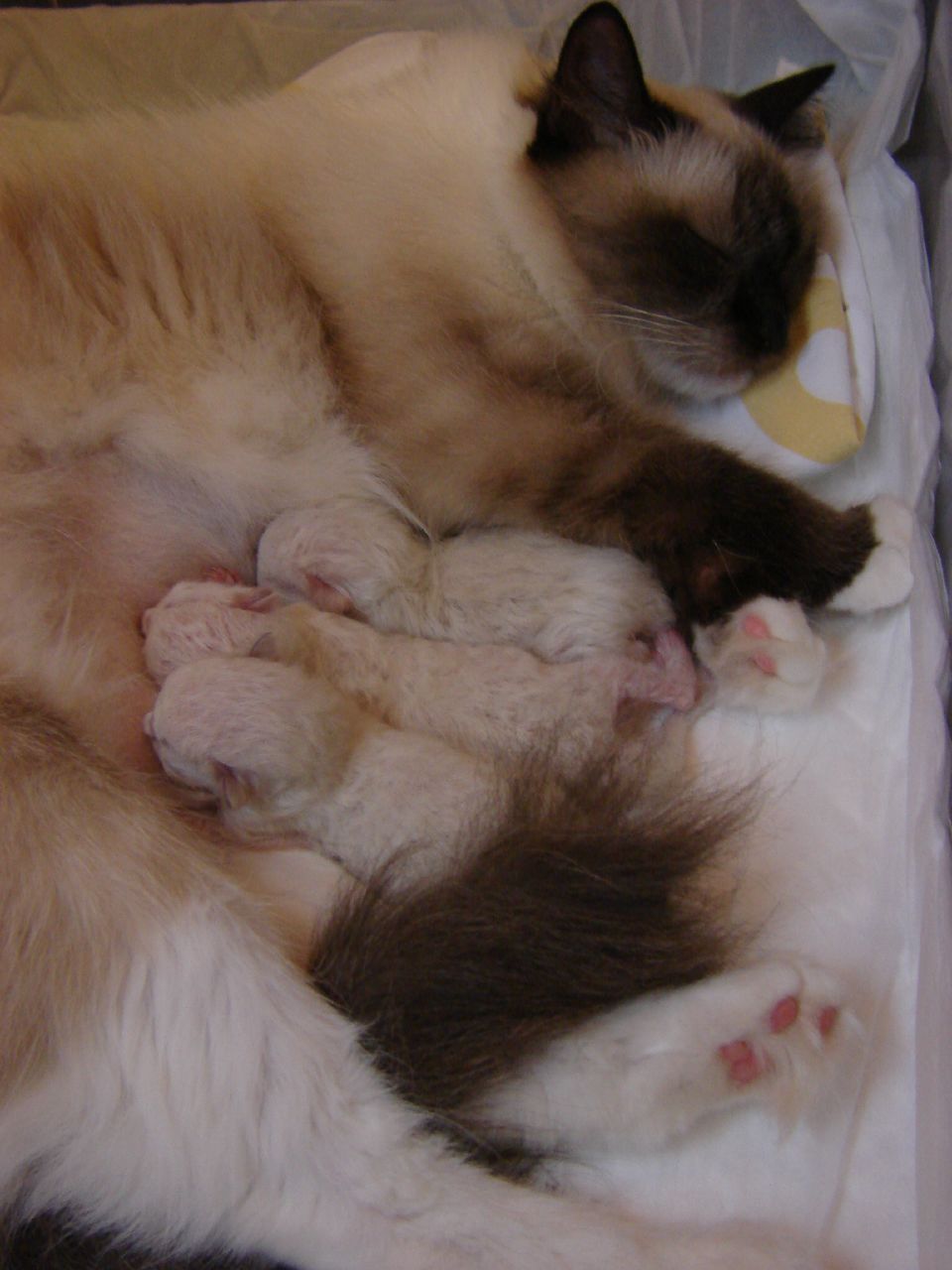
Baby cats are called kittens, their mother is a queen.  Read more about How Cats have Kittens.


photo source
This is a mother dog,  her babies are called puppies, the act of giving birth in dogs is called whelping.  Read more on Whelping


Happy Mothers Day!


Note:  Although baby animals are cute, you should not let your pet breed unless you have qualified people looking to take the off spring.  This is particularly true of cats and dogs, as in the United States over 4 million excess pets are produced every year, and are euthanized.  Keep in mind that not every female animal wants to be a mother, and some will not survive the pregnancy or giving birth.  Sometimes mother animals will not care for their young, and you have to be a foster parent.

Wednesday, November 24, 2010

Exotic Pet Skunks

Here at the cabin we have a couple of barn cats that live outdoors (they have a dog house for shelter and several barns - both cats are neutered of course and brought into the house when its very cold, althogh they prefer to be outside).  We leave bowls of cat food out for them, including one bowl on the deck.  Sometimes this food seems to vanish overnight.   We have seen who is stealing the food on a couple of occasions.  A skunk!  This cute skunk is easy to chase off and has never sprayed us or the cats. 

Above you see he/she spilled the big container of cat food.  The crash alerted me.

In our area skunks are not allowed as pets although this one seems to think we are in charge of feeding it!  Some people do keep skunks as pets, they can be very ferret like in behavior with the main concern in that pet skunks (and all skunks) are nocturnal.  As well an exotic pet, like a skunk, should never be caught wild (in most cases this is illegal) rather they should be purchased from a breeder, or adopted from a rescue group. 

Read more about the Care for Pet Skunks - click here.
Read more about Skunks in General - click here.

Wednesday, November 17, 2010

Cutest Bunnies in the World

At the Animal Cabin we like all kinds of animals, from tiny bugs, to massive creatures, but of course we also love looking at some cute critters, and what could be cuter than a bunny?

Writer RJ Evans is noted for his original sense of humor, and ability to find the most awesome pictures!
He must be a Star Trek fan too because in this link he references one of Star Treks most famous animals - the Tribble.

The Angora rabbit is Earth's version of the Tribble, and nearly breeds as fast!

photo source
If you think this Angora bunny is cute you will want to check  RJ's article The Real Life Tribble - click here.

Angora rabbits are not easy pets to care for, they require regular grooming or their hair can become a real problem for them.  If hair around their rump is allowed to become dirty it can attract flies which can lead to a deadly problem - fly strike.

Discount Pet Supplies at ThatPetPlace.com

Read more about angora rabbit breeds.
See other cute rabbit breeds.

Saturday, November 13, 2010

Green Anole Lizards

Green Anoles are commonly kept as house pets.  Sadly many do not live long as many people do not gather enough information on their care and requirements.

These small lizards require a warm tank, at least 7.5 gallons, however 10 or even 15 gallon tanks are better.

Males are more often seen in the pet trade and will fight and kill each other as they mature.  Females are generally held back by breeders.  The males have the larger red pouch they can inflate. 


Photo By Huzzar  [Public domain], via Wikimedia Commons

Anyone wishing to get one of these small lizards as a pet should do more research, learn about the animal, its needs, and decide whether or not you can meet these, and that this is indeed a pet you want - for the right reasons.

An Anole (say Ah - No - Lee) is a good starter lizard for somebody who is truly interested in keeping larger species of lizard.

Although stores often sell Anole food many animals prefer live food so you must be able to provide them with live crickets.  They can be handled but if stressed will drop their tail (let it fall off).

Anoles like tropical tank conditions.  

Discount Reptile Supplies at www.thatpetplace.com

To Learn more about keeping Green Anoles as Pets, Click Here.
To see some Macro Photography Images of Green Anoles, Click Here.

Sunday, November 7, 2010

The Shaggy Donkey of France

One of the rarest donkeys is the shaggy Poitou Donkey of France.

Here at the cabin we enjoy sharing information about such unusual animals, ones that many people will never see in their lifetime, but hopefully whose species can be saved.

In France these shaggy donkeys are called Baudet du Poitou. These donkeys are so rare there are less than 300 purebreds even today.


The Baudet de Poitou is a fairly large donkey, standing 13 to 15 hands high (a hand is 4 inches or 10 cm). The most recognizable feature is their long hair, known as “cadenette” which hangs down like dreadlocks. In color they are always dark brown or black, but with a white tummy and nose.  The Baudet de Poitou donkey has lighter hairs around the eyes. They lack the dark dorsal stripe seen in most other breeds. Their long hair is a dominant trait and crossbred animals will have this feature as well.  

Because the long hair is dominant it means that part bred animals will have the long hair so unscrupulous sellers might try to suggest their part-bred Poitou is in fact a purebred, always get proof of parentage with registration papers.  Like most animals these hairy donkeys cannot legally be called purebreds unless they have registration papers proving the same.   

Get 5% off SLT.com

5% off Any Size order on Horse.com

Read more about these shaggy donkeys - click here.
To read about the differences between horses, mules, and donkeys - click here.
To read a true story about my standard donkey - click here.


Saturday, October 23, 2010

Bats in the Barn

This past summer, when shutting the barn door, many nesting bats fell out of their cozy nesting spot.  It was quite a sight to see, they squealed and made their way back up the wall of the barn to find their nest (it was a sliding door that had been left open most of the summer and they had made a next between the open door and exterior of the the barn.

By the time I got my camera most had climbed back to safety.
You can read the full story here.

As a result of this I spent some time on the Internet researching bats and was alarmed to find that a mysterious disease is killing them by the millions (not in my area).  This disease is known as "White-Nose Syndrome" and is one of the worlds largest disasters in terms of animal life being lost at the moment.   You can read more about White Nose Syndrome in bats here.

Sunday, October 3, 2010

What Color are Zebras?

Sometimes we will hear somebody ask if Zebras are black with white stripes or white with black stripes.  The trick to answering this is to look at their skin color, which we can see on their muzzle area.  The skin of the zebra is black, as such we can see that the Zebra is a black animal with white stripes. 

By American Library of Congress (http://www.dinosoria.com/mammifere/zebre_100.jpg) [Public domain], via Wikimedia Commons

Lots of horse loving girls (and boys) think owning a Zebra would be pretty cool, however these animals are not commonly kept as "pets" simply because they are hard to domesticate, or tame.  In the photo a team of four zebras is actually three zebras and a more tame - horse!

Zebras can be kept as pets in some areas, permits are required and they need to have sufficient space.  These are not pets suitable for everyone, and should only be kept by those interested in zebras as an animal - not for the sake of getting attention by having an unusual equine!


You may be interested to know that there are many different kinds of zebra each with its on unique traits.  Feel free to read some more interesting facts about these amazing animals, click here.