Tuesday, February 21, 2012

Peruvian Pasos, Exotic Horses


For as long as I can remember I have been a horse crazy girl. Neither of my parents were horse people so it was rather hard to convince them to buy me a horse, however I did manage to convince them to get me riding lessons. The riding lessons were your typical English riding lessons, done in groups on lesson horses.


One year the stable, which was in Edmonton, hosted a showcase of different horse breeds. One of the breeds that attended were Peruvian Pasos. While horses are not really “exotic pets” the Peruvian Paso certainly qualifies as an exotic type of horse.

The Peruvian Paso not only looks exotic but has two very unique gaits for which it was bred. These gaits are the Paso Llano and the Sobreando. Both are four beat lateral gaits, left hind, left front, right hind, right front. The Sobreando is slightly faster with a pause between the second and third step.

At the showcase of the breeds there were a few Peruvians, the one I remember best (this was almost 30 years ago) was a Palomino named Gato del Sol, cat of the sun. I remember him because I actually got to ride him. As part of the breed showcase people were allowed to ride some of the horses. I rode him (this being only for a few minutes) but wow I can honestly say he was smooth like silk. He also had a beautiful thick mane and tail; characteristics of the breed. They do not even cut a bridal path.


photo source - The gaits of the Peruvian Paso are natural and foals perform them from a young age, it almost looks like a trot here, but is not.

All in all these are very showy, beautiful, horses which, I think, qualifies them as exotic!

Peruvian Pasos are fairly rare, with less than 30,000 worldwide. Peruvian Paso horses originated in Peru but there are several breeders in the States and Canada (at least two breeders right here in Alberta). Some breeders have been criticized for trying to change the breed. Horses should stand between 14.1 and 15.2 hands but some people want to make them taller, others try to make them faster and have altered the gait too much in the opinion of other purist breeders. If you are looking for a Peruvian Paso try to familiarize yourself with the breed and only buy from a breeder who is sticking with correct breed standard.

To see more pictures and learn more about the Peruvian Paso, Read Here.

If you are a kid and want to try to convince your parents to buy you a horse (good luck) you can Read Here.

Saturday, February 11, 2012

A Basic Introduction to Toucans, Toucanets and Aracaris

When I was young, growing up in Edmonton, Alberta, I remember often visiting Meadowlark Mall, yes it was a thriving mall in those days, before West Edmonton Mall was developed. Anyhow, there was a department store in the mall, Zellers, and in the back left corner was their pet section. For the longest time I remember they had a Toucan for sale.

The toucan sat in a small cage, not much bigger than the cages we now see finches in. It was a beautiful bird. This was almost 40 years ago. I do not know if that bird ever sold, or what became of it. At some time Zellers stopped selling pets (yeah!), and eventually the mall itself changed. Today I was reminded of that bird when answering a question on WebAnswers about Toucans.

As Toucans, and their smaller relatives, the Toucanets, are favorite birds of my husband I was inspired to write about them and learn more about them than I had in the past.

©Art work by my husband, Mark Gordon Brown - Emerald Toucanet.


Toucans, toucanets, and a smaller relative the aracaris, are softbills, birds that use their bills for eating soft fruit and berries. They will also eat insects, small lizards, and in the wild have been know to eat eggs and baby birds of other species.  The term "soft-bill" refers to their diet of soft foods.

As pets they have some advantages over parrots although they may be considerably harder to find in stores.

Toucans are generally quieter than parrots.

Toucans do not have the ability to bite as hard as a parrot.

Because they eat fruit and berries, toucans are less messy than parrots who eat nuts and seeds.

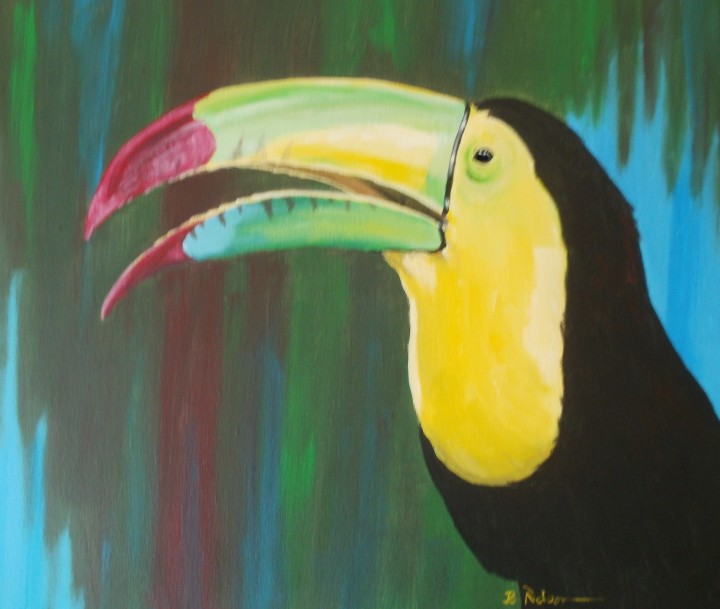
© Art work by Brenda Nelson Keel-billed Toucan

The biggest disadvantage is that toucans really need proper flying space, so they need larger cages (tell that to the people who housed the toucan at the mall department store earlier mentioned). Where as a parrot can sit on top of its cage and play with toys, toucans really thrive when they can stretch their wings and fly.

Toucans are not as common as pets as parrots, even now I seldom see them in pet stores. Of course if you were looking to buy one I would not suggest a pet store anyhow, but would recommend you look for a proper breeder or avian enthusiast.

I hope you have enjoyed learning a little bit about toucans, toucanets, and aracaris.  If you wish to learn more about them as exotic pets please read:  Information on Toucans and Toucanets as Pets

Tuesday, January 17, 2012

About Sea Monkeys

As you probably guessed, Sea Monkeys are not monkeys at all. They are actually a crustacean known as brine shrimp. 

Brine shrimp were marketed as pets in 1957 under the name Instant Life, the name was changed to Sea Monkeys in 1962.

Initial packaging showed them as being almost human like, or I should say monkey like, often wearing crowns or carrying little pitchforks.  Many children (and some parents) were disappointed to see nothing like their depiction.

How to Care for Sea Monkeys as Pets
Sea Monkeys require special water conditioning, and cannot survive in simple tap water. They need water that has chlorine removed, and salt added. When purchased as “Sea Monkeys” they come with packages for conditioning the water and adding salt. It is actually recommended to leave water out for 24 hours to reach room temperature and to naturally evaporate the chlorine before the “Water Purifier” package is added.

Sea Monkeys are also sold as eggs with instructions and food which is yeast and spirulina algae.


Interesting Facts on Brine Shrimp

The variety of brine shrimps sold as Sea Monkeys is a hybrid known scientifically as Artemia NYOS.

Brine Shrimp have been around for millions of years, and are very much unchanged from the Triassic time.

Brine Shrimp eat algae which turn them pink, eating them is what turns flamingos pink.

Brine Shrimp live about one year.

Brine Shrimp eggs can survive two years if hatching conditions are not right.

Brine Shrimp are often fed, life, freeze dried, or frozen, to fish.

Brine Shrimp are a very unusual type of animal; they can enter a state of self preservation where they can be dried up, and can revive themselves when conditions are more favorable to life. For example, brine shrimp living in Botswana live in ponds that dry up for part of the year, they remain dormant – virtually dead, until water returns to their pond.   

Saturday, December 24, 2011

How to Feed a Pet Skunk


If you own a pet skunk, or are thinking about getting a pet skunk you will hear a lot of conflicting information in regards to feeding.  This is in part because very few studies have been done on skunk nutrition, and as well because all food companies that make skunk food (there are only a few) will tell you that their food is the "best".  

In the past a lot of skunk owners have fed cat food or ferret food to their skunk, but both are too fatty and contain too much protein. Skunks fed these diets often became obese.  Many skunk owners now consider feeding a top quality, grain free, dog food to be better (do not contain BHA, BHT, by-products, corn gluten meal, or brewers rice).  However the concern is that the skunk still requires taurine - an ingredient not found in dog food.

Skunk owners can purchase taurine in powder, liquid, or tablets. Taurine should be feed at 200 mg per day. Calcium supplements are also a good idea.  Both can be purchased at a health food store (some pet stores may carry these too).

A skunk's diet should be roughly 65 % meat and dairy products, 30% vegetables, and 5% fruit.

Vegetables can be fresh or frozen (and thawed), canned vegetables tend to be lower in nutritional value.  Skunks should not have asparagus, onions, or iceberg lettuce.

Fruits is safe for skunks except for grapes and avocados. Fruit should be given only two or three times a week, not daily.

Skunks can eat nuts, excluding salted nuts, almonds offer a good source of Vitamin E.

Pet skunks can eat eggs (boiled – shell and all), and most dairy products (including goats milk) except whole milk, cream, and high fat cheeses. You should not feed your skunk yogurt with artificial sweeteners (aspartame), which are often found in low-fat yogurts.

Skunk owners can also purchase crickets, mealworms from pet supply stores. Live crickets may escape so most owners prefer to buy dried crickets.  You can dig up worms for your skunk, but most people prefer to leave the worms in the garden where they are beneficial.

Skunks under 4 months of age should be fed 3-5 small meals a day, do not feed a skunk free choice, it will eat too much and become obese. Adult skunks can have 3 meals a day.  For many skunk owners this means feeding early in the evening, later at night, early in the morning.  Watch to see how much your skunk can eat in 20 minutes time, and remove uneaten food after that.  Monitor your skunk for weight loss or gain and overall signs of eating right.

Skunks are natural foragers, if you leave any food out they will find it, and can open cupboard doors while searching for food.  Keep chocolate of of a skunk's reach it is toxic.

Skunks should have their food and water in stainless steel or ceramic bowls that are built so they do not tip or spill.


Indications of a Skunk with a Diet Problem:

A fat skunk is not a healthy skunk.  You can reduce the amount of food you feed in the winter as they naturally would find less to eat in the winter and this will help reduce the skunk's weight.

A skunk that is skinny and drags its hind legs could be suffering from a lack of calcium.

Hair loss, particularly on the back and tail, indicate an improper diet (or mites).

A skunk with vision problems may be suffering from a lack of taurine.

If a skunk's white fur looks yellow this may be a sign of poor care, or a poor diet.

Further Reading on Feeding and Care for Skunks

Thursday, December 8, 2011

Bobcats as Exotic Pets

Many people are looking for more exotic, more unusual, slightly more dangerous, exotic pets; but they still want cute!  As such bobcats and lynxes are now being considered as pets and are slowly entering the exotic pet market.

I personally do not feel a need to own such a creature but did a lot of research on ownership of them which I present to you now. 

In most areas you will require a licence or permit own own a pet bobcat or pet lynx.  Depending on your area this may require getting your property inspected for security.  Your local zoning may be an issue too.  You can only acquire these exotics from licenced breeders who are required to check your permit before selling to you.  Note that you cannot catch and keep a wild bobcat or lynx in most areas as this is illegal, not to mention cruel and dangerous.


Bobcats are about twice the size of a domestic cat, and the Canadian lynx is slightly larger, so you must be sure you can accomodate such a big animal, offering it enough room to play, and as well you must consider the higher costs of feeding and over all care.

Some people breed their own rabbits for the purpose of feeding their pet bobcat or lynx, others use premium commercial diets.  Meat must be the main part of the diet as, like all cats, bobcats are true carnivores. 

You need to be certain you have a veterinarian willing to treat and care for such an exotic pet. 

Keep in mind that a bobcat or lynx is very playful, they will be more destructive than a regular house cat and require plenty of things to climb on.  They may also see any smaller pets as prey.  Like most cats they spend the majority of their day sleeping, but like to be awake in the morning and evening.

If you are intersted in getting a pet bobcat or pet lynx the first thing to check is what licensing and/or permits are needed in your area.  Contact a breeder to see what their requirements are in terms of space and fencing, as most breeders insist on doing home checks before selling to a buyer - they may require a deposit made before they actually have kittens ready to sell.

You should plan on spending $1200 - $1800 USD to purchase a pet bobcat.  Make sure it has been vet checked and vaccinated first.  It should be no younger than 8 weeks of age and should come with health guarantees.

Sunday, December 4, 2011

Fainting Goats

Back in 1880 four goats were abandoned by a Canadian man in Tennessee, these goats soon had kids and somebody noticed a peculiar trait among their offspring.  It seemed when they got a sudden scare they fell over as if in a trance.  The condition was recognized as a rare condition that also occurs in humans, myotonia congentia.

When given a sudden scare the muscles in the legs of the goats freeze up, the animal quickly topples over as a result and may lay there frozen for 10 seconds or so.  For many years Myotonic goats were used as meat goats, intentionally scared so they would build up muscle in their leg from repeatedly freezing up.  Now they are more likely to be kept as pets or occasionally for cashmere fiber that some produce in the winter.


Myotonic goats are also called fainting goats and are smaller goats, often black and white, but they can be any color.   They are pretty easy to keep, needing shelter in cold and wet weather, and they are less likely to climb fences than other goats. 

If bred to another goat the fainting gene is recessive.  Younger fainting goats are more likely to fall over as the older ones learn how to brace themselves.  Of course any animal that falls down when frightened may be an easy target for predators, or thieves.  As such it is a good idea to keep your goats well fenced and secure.  


Read here if you wish to learn more about goats and goat care.

Friday, November 11, 2011

Pet Spiders

Todays' article is on Keeping Pet Spiders, by Jerry Lee Hall

Spiders' Increasing Popularity As Exotic Pets
Spiders can be really be amusing to observe. They move about quietly and are known to cope well in several types of environments. Maintenance is likewise not very difficult as they are generally clean and don't leave much clutter. These reasons account for the growing popularity of keeping spiders as exotic pets.

However, as spiders are generally seen as low-maintenance pets, owners at times fail to recognize that taking care of them is, in fact, not that straightforward. There are still many things to take into consideration. Thus, having spiders as pets as a result of mere influence of their popularity shouldn't be the case. You must also remember that, just like in taking care of other types of pets, a high level of responsibility is involved.

If you are a first-time owner, it would be wise to choose those which are neither fragile nor treacherous. Tarantulas like Chilean rose, Mexican Redleg, and Costa Rican Zebra are well suited to being pets. Their venom isn't very harmful but is instead similar to that of the bees.

Strength of venom is one of the important things that you have to check at the very start of your search for an exotic pet spider. Mild venom may cause significant pain. Hairs on their abdomen are equally harmful as they may shed it in moments of threat and stress and may cause irritation and great hazard when they get into the eyes. You have several options but, in general, prior to acquiring any type, you have to check with your local government if there are policies regulating such.

To maintain a spider's suitability to become pets, you have to create a habitat that closely mimics their natural living environment. This need not be expensive, or spacious, as a simple terrarium may be enough. You also don't have to worry about giving spiders companions of the same species as they are usually not after socialization. By nature, they are also predatory thus they may just end up eating their companion even if it is a fellow spider. What you have to check is the enclosure as spiders are good climbers and they can easily pass through small holes or crevices. They may escape if their habitat isn't secure enough.

Taking care of spiders indeed isn't that easy. They deserve respect just like any other animal. At the same time, you also have to protect yourself from possible harm that they may inflict. Overall, acquisition must be a result of careful research and consideration.

The Animal Cabin would like to add:
As with buying any pet be sure to buy from a reputable breeder.  Spiders are sometimes sold in pet stores but also are often sold at reptile and herp shows and sales.  Reputable pet spider breeders often advertise in reptile and amphibian shows.
Make sure you are instructed on how to feed your new pet spider as well as how to handle it carefully, dropping a spider can kill it.