Recently in the United Arab Emerates there have been some stories of Cheetahs suffering as exotic pets. These tales should serve as a warning for anyone considering getting such a wild cat for a pet.
In the UAE, Cheetahs, and other exotic pets, are often kept on the rooftops of buildings, often on chains. In a recent story which made news May 29, 2011, a Cheetah cub, about seven months old, was found wandering the streets with an injured front paw. The Al Rahma Animal Welfare and Resuce Society speculates that the big cat's paw was injured in a fall, or jump, from its roof top home. Additionally it had a metal chain around its neck. Very likely the cat had been on a chain, which may have broken, or been cut, when the animal fell, or broke some other way.
At any rate the cheetah cub was found in the Karama district of Abu Dhabi, and later sent to a wildlife rescue place.
This cheetah was not the first exotic pet, or big cat, to make news in the area, sadly it is only one of many, including cases where smugglers have been caught with kittens, and and even worse recent case where officials saved two lions from a home where both were suffering in horrid condition as the result of neglect, and abuse. Both lions had been declawed, as well their teeth had been filed down and had become infected.
Read More on the Cheetah's Rescue and see a Picture.
Al Rahma Animal Rescue in Abu Dhabi - Facebook Page
Over all if you are thinking that a big cat is a good pet... think again. These cats require a lot of meat, they need a lot of space, and they are dangerous. Even if well handled they have a potential to harm, as well the human lifestyle is not at all natural for such an animal. Cheetahs, need to run, they were made to stretch their limbs and run. They are not status symbols. A far more suitable pet would be a greyhound, or Bengal Cat.
Sunday, May 29, 2011


Thursday, May 19, 2011
The Tiger Mom and the Piglets
Sometime in 2006 an e-mail circulated about a female tiger nursing piglets to overcome her depression at the loss of her tiger cubs.
I remember seeing this in 2007 and later did a search on it only to discover the whole thing was a fake. The truth was a little depressing.
The tiger mom and the piglets were part of an entertainment feature at the Sriracha Zoo in Thailand. This zoo is noted for having a tiger breeding program in which cubs are raised to be used in circuses or for sale to other zoos. As such the cubs are probably taken from their mothers at a very young age and raised by people - or placed with a sow for equal entertainment value, at least for the hours people visit the zoo.
The zoo went so far as to dress the piglets like tigers, but apparently this was also just for show, as the tiger skins were removed after the zoo closed.
To say if this is cruel or not is a person's own opinion. It certainlly is not natural, although there have been some true stories where animals of one species raise young of an other (rarely a dog may raise a kitten, or young squirrels). Nutritionally one would have to assume both the piglets and the tiger cubs were also fed special formula for their species. In some cases visitors were allowed to bottle feed the young animals. The Srirahca Tiger zoo would not be a place I would have on the top of my list to visit.
It is interesting to note that there are currently more tigers in captivity than in the wild, yet many of the captive tigers are inbred to the point they have health issues, and short lifespans.
Further Reading On Pet Tigers and Zoos
Facts on Pet Tigers
So... You want a Pet Tiger... Other ways of having a Pet
Issues of Zoos
I remember seeing this in 2007 and later did a search on it only to discover the whole thing was a fake. The truth was a little depressing.
The tiger mom and the piglets were part of an entertainment feature at the Sriracha Zoo in Thailand. This zoo is noted for having a tiger breeding program in which cubs are raised to be used in circuses or for sale to other zoos. As such the cubs are probably taken from their mothers at a very young age and raised by people - or placed with a sow for equal entertainment value, at least for the hours people visit the zoo.
The zoo went so far as to dress the piglets like tigers, but apparently this was also just for show, as the tiger skins were removed after the zoo closed.
 |
| one of the pictures from the circulated e-mail |
It is interesting to note that there are currently more tigers in captivity than in the wild, yet many of the captive tigers are inbred to the point they have health issues, and short lifespans.
Further Reading On Pet Tigers and Zoos
Facts on Pet Tigers
So... You want a Pet Tiger... Other ways of having a Pet
Issues of Zoos
Wednesday, May 11, 2011
The Slow Loris is an Illegal Pet
The slow loris is a primate that has gained attention through a few YouTube videos. As so often happens when "cute animal" videos come out, somebody insists they want to obtain that animal as a pet. The slow loris, however, should not be kept as a pet.
Slow loris are native to southeast Asia where it is illegal to capture them from the wild; owning them, and selling them, is also illegal. Many slow loris are poached from the wild for the purpose of resale in bird and pet markets, or are shipped to other countries for sale in pet stores. In these stores they are often listed as being "captive bred" however this is usually not the case, but nearly impossible to prove. Even if they were captive bred, the parent animals were stolen illegally from the wild.

photo source
The real cruelty is the fact that slow loris are put at risk by having their teeth pulled, or cut, before they become part of the exotic pet trade. If rescued from markets they cannot be returned to the wild because without teeth survival is difficult.
The slow loris has a poisonous bite. To deal with this the poachers will cut their teeth with pliers or nail clippers, or yank them out. Veterinarians are not involved because aiding the poachers would be illegal. The poor little animals are given no pain killers, and nothing to fight infection. Many slow loris stop eating as a result of the pain, or die from infection. There is no way of knowing just how many slow loris die, but estimates suggest that many get infections which are often fatal and others die of stress or malnutrition.
Make no mistake, the slow loris, although cute, should not be part of the exotic pet trade. If you happen to see a slow loris for sale in an illegal pet market, DO NOT buy it, this only rewards the seller. Rather you are suggested to call police or other animal welfare authorities, who will take the animal and place it in a rescue. This hurts the seller and hopefully they will stop their involvement in the cruel trade of this beautiful animal.
Please read more about the Slow Loris .
Slow loris are native to southeast Asia where it is illegal to capture them from the wild; owning them, and selling them, is also illegal. Many slow loris are poached from the wild for the purpose of resale in bird and pet markets, or are shipped to other countries for sale in pet stores. In these stores they are often listed as being "captive bred" however this is usually not the case, but nearly impossible to prove. Even if they were captive bred, the parent animals were stolen illegally from the wild.

photo source

The real cruelty is the fact that slow loris are put at risk by having their teeth pulled, or cut, before they become part of the exotic pet trade. If rescued from markets they cannot be returned to the wild because without teeth survival is difficult.
The slow loris has a poisonous bite. To deal with this the poachers will cut their teeth with pliers or nail clippers, or yank them out. Veterinarians are not involved because aiding the poachers would be illegal. The poor little animals are given no pain killers, and nothing to fight infection. Many slow loris stop eating as a result of the pain, or die from infection. There is no way of knowing just how many slow loris die, but estimates suggest that many get infections which are often fatal and others die of stress or malnutrition.
 |
| photo source |
Make no mistake, the slow loris, although cute, should not be part of the exotic pet trade. If you happen to see a slow loris for sale in an illegal pet market, DO NOT buy it, this only rewards the seller. Rather you are suggested to call police or other animal welfare authorities, who will take the animal and place it in a rescue. This hurts the seller and hopefully they will stop their involvement in the cruel trade of this beautiful animal.
Please read more about the Slow Loris .
Sunday, May 8, 2011
Happy Mothers Day, Pictures of Cute Baby Animals
Mother's Day is celebrated on different days all over the world, here in Canada, Mother's day is the first Sunday in May. To celebrate this day I wanted so share with you some pictures of cute baby animals and their mothers.

 |
| photo source |

A baby horse is called a foal, it is either a filly, if female, or colt, if male. Learn more about Horses and Foaling

A baby llama is called a cria. Learn more about Llamas
 |
| photo source |

Baby hamsters are called pups, you can read more about Hamsters as Pets
 |
| photo source |

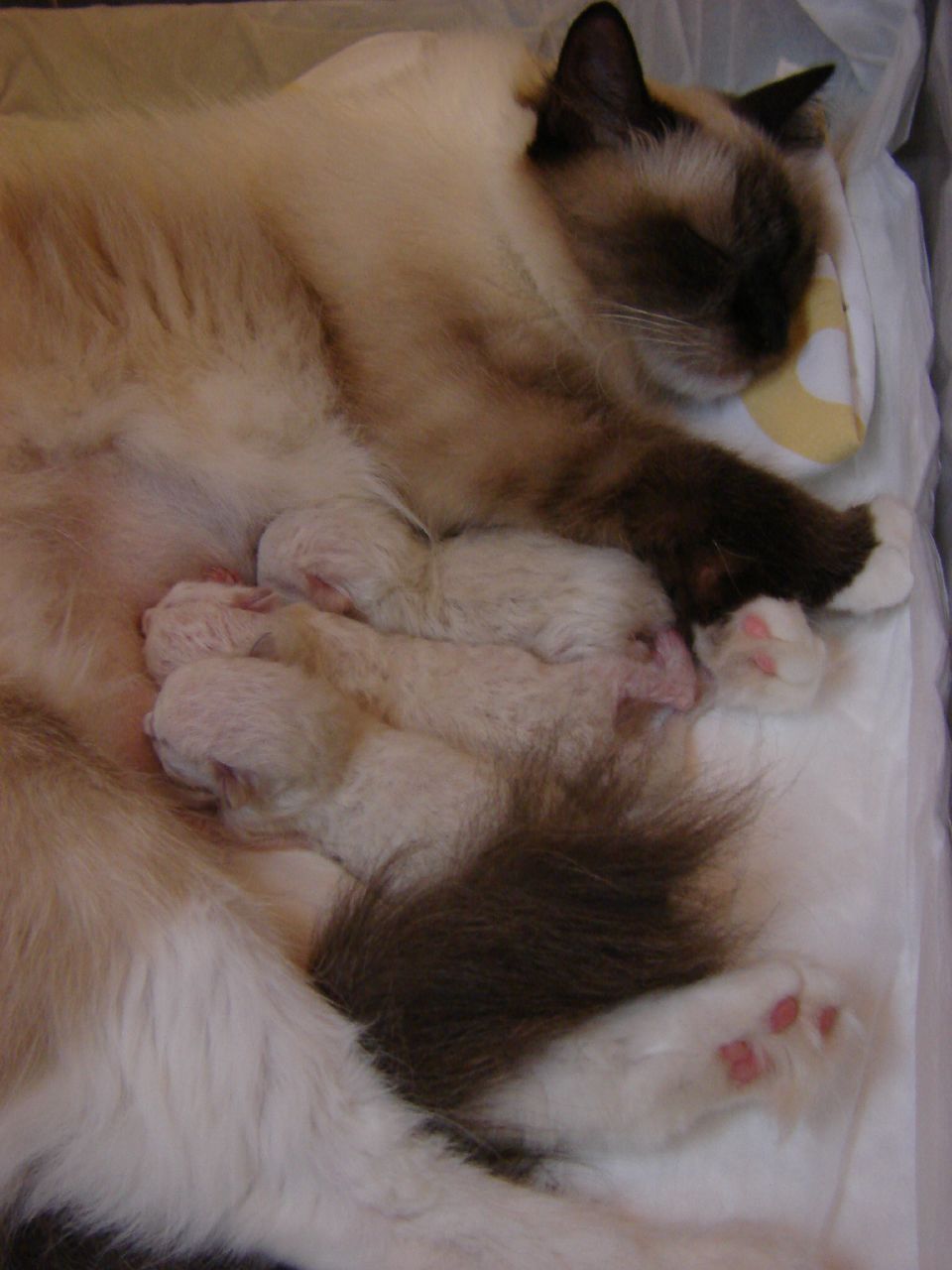
Baby cats are called kittens, their mother is a queen. Read more about How Cats have Kittens.
 |
| photo source |

This is a mother dog, her babies are called puppies, the act of giving birth in dogs is called whelping. Read more on Whelping
Happy Mothers Day!
Note: Although baby animals are cute, you should not let your pet breed unless you have qualified people looking to take the off spring. This is particularly true of cats and dogs, as in the United States over 4 million excess pets are produced every year, and are euthanized. Keep in mind that not every female animal wants to be a mother, and some will not survive the pregnancy or giving birth. Sometimes mother animals will not care for their young, and you have to be a foster parent.
Wednesday, April 27, 2011
Mules, Donkeys, Burros, and Horses
Horses, Donkeys, and Mules have so many things the same, but are actually very different when you get right down to it.
Most people only think of the ears, donkeys have big ears, horses have relatively small ears, and mules have ears that are in between. There are many other differences between horses, donkeys, and mules... which you can read about by following the link at the bottom of the page.
Oh wait, did we forget to mention Burros? Not Really! Burro is just another name for a donkey. In some places "Burro" is the term used for the smaller donkeys. Just as horses come in different sizes, including miniatures and ponies, so too do donkeys, from the large, mammoth donkeys, to the smaller, miniature donkeys.
A mule is a cross between a male donkey, a jack, and a female horse, a mare. Mules are hybrid animals and they have an odd number of chromosomes (63) and as such they are typically sterile, although a few female mules (jennys) have been known to have foals, it is very rare.

Read More (and see more pictures) about the Differences between Horses, Donkeys, and Mules.
Read More about Pet Donkeys.

Most people only think of the ears, donkeys have big ears, horses have relatively small ears, and mules have ears that are in between. There are many other differences between horses, donkeys, and mules... which you can read about by following the link at the bottom of the page.
Oh wait, did we forget to mention Burros? Not Really! Burro is just another name for a donkey. In some places "Burro" is the term used for the smaller donkeys. Just as horses come in different sizes, including miniatures and ponies, so too do donkeys, from the large, mammoth donkeys, to the smaller, miniature donkeys.
A mule is a cross between a male donkey, a jack, and a female horse, a mare. Mules are hybrid animals and they have an odd number of chromosomes (63) and as such they are typically sterile, although a few female mules (jennys) have been known to have foals, it is very rare.

Horses on the left, a standard donkey on the right.
One of the reasons why people breed horses and donkeys together to make mules is because while horses are strong, they do not have the endurance of a donkey and require more food. Donkeys are smarter than horses and will be safer when travelling on dangerous ground. Mules make excellent work animals as a result of this combination.
Read More (and see more pictures) about the Differences between Horses, Donkeys, and Mules.
Read More about Pet Donkeys.
Tuesday, April 19, 2011
Innisfail Odd and Unusual Animal and Bird Auction
If you are in Alberta and looking for an odd or unusual exotic pet, the Innisfail Odd and Unusual Animal and Bird Auction is not to be missed. This is a three day event that happens twice a year, Easter weekend, and Thanksgiving weekend.
The Easter sale will begin on Good Friday, with goats and sheep selling in the day. Later in the evening Aniques, Collectables, and most caged pets will sell (sometimes including some caged birds), this is often hedgehogs, sugar gliders, guinea pigs, and a few reptiles, but can be animals such as wallabies. Many exotic pets sell at this time - different every auction!
On Saturday, the other birds will sell, these being exotic chickens, pheasants, peafowl, emus, and who-knows-what! Rabbits will also sell on Saturday. Many caged birds also sell on Saturday.
On Easter Sunday, the miniature horses, exotic cattle, llamas, and other large mammals (bison, elk) will sell.
The Thanksgiving weekend sales run the same way, Friday to Sunday.
Anything is possible - it all depends what sellers bring. I have attended many of these sales, we have seen many exotic pets and animals at this sale, every thing from tiny baby snakes, to a halter trained bison. We have seen rare breeds of livestock, and a few regular ones!
Some exotic pets that are auctioned off require special permits to own, (such as migratory birds, or primates) so make sure you bring your permits if you plan on buying certain exotics. Come early to have a look around, get your bidder number, and find a seat. If you are selling - come even earlier!
Innisfail is just south of Red Deer, Alberta, on highway 2, about an hour north of Calgary. The auction market is just off the highway at the south end of town.
To see Other Sales Dates - click here.
Further Reading
Buying and Selling at Exotic Animal Auctions
Starting a Petting Zoo
How to get a Better Price for your Horse, when Selling at Auction
 |
| As seen at the Innisfail Auction |
On Saturday, the other birds will sell, these being exotic chickens, pheasants, peafowl, emus, and who-knows-what! Rabbits will also sell on Saturday. Many caged birds also sell on Saturday.
On Easter Sunday, the miniature horses, exotic cattle, llamas, and other large mammals (bison, elk) will sell.
The Thanksgiving weekend sales run the same way, Friday to Sunday.
 |
| Pheasant we purchased at the Innisfail auction. |
 |
| Zebu seen at the Innisfail Auction |
Innisfail is just south of Red Deer, Alberta, on highway 2, about an hour north of Calgary. The auction market is just off the highway at the south end of town.
To see Other Sales Dates - click here.
Further Reading
Buying and Selling at Exotic Animal Auctions
Starting a Petting Zoo
How to get a Better Price for your Horse, when Selling at Auction
Wednesday, April 13, 2011
Walking Stick Insects as Pets
A few years ago my husband, daughter, and I, attended an Odd and Unusual Action (in Innsfail, Alberta) in which exotic livestock and pets are sold. We came home with 3 jars of Northern Walking Stick insects, with 3 in each jar for a total of 9 new pet bugs. After almost three years, we had more than 300 of the little creatures.
Walking stick insects are great pets for people with limited space (we kept ours in a 10 gallon tank), or who have allergies to furry pets, or who want a cheap and easy pet.
In the summer we fed our pet insects leaves off our apple trees, in the winter we fed them leaves of romaine lettuce (other lettuce does not have enough nutrition). We only had two bad experiences - once when we forgot to wash the store bought leaves and all the adults died, however a few weeks later we notice little ones in the tank, so clearly there were some unhatched eggs. The other bad experience was when the mesh lid was not shut tight enough and a few insects escaped. We found them on the walls and curtains for the following few days.
In addition to food they also require a water source, such as a wet sponge or damp soil. We misted the tank several times a day. In the picture you can see a larger adult on an apple leaf and a smaller adult on a stick. They do require sticks so they can shed their skin.
 Read more about Care for Walking Stick Insects
And another on Care of Walking Stick Insects
Read more about Cheap and Easy Pets
* Please Note in most areas it is illegal to set any unwanted walking stick insects loose into the wild. If you have found you have more than you can care for you must dispose of them, by selling them, freezing them, or feeding them to lizards.
Walking stick insects are great pets for people with limited space (we kept ours in a 10 gallon tank), or who have allergies to furry pets, or who want a cheap and easy pet.
 |
| click for pet supplies |
In the summer we fed our pet insects leaves off our apple trees, in the winter we fed them leaves of romaine lettuce (other lettuce does not have enough nutrition). We only had two bad experiences - once when we forgot to wash the store bought leaves and all the adults died, however a few weeks later we notice little ones in the tank, so clearly there were some unhatched eggs. The other bad experience was when the mesh lid was not shut tight enough and a few insects escaped. We found them on the walls and curtains for the following few days.
In addition to food they also require a water source, such as a wet sponge or damp soil. We misted the tank several times a day. In the picture you can see a larger adult on an apple leaf and a smaller adult on a stick. They do require sticks so they can shed their skin.

And another on Care of Walking Stick Insects
Read more about Cheap and Easy Pets
* Please Note in most areas it is illegal to set any unwanted walking stick insects loose into the wild. If you have found you have more than you can care for you must dispose of them, by selling them, freezing them, or feeding them to lizards.
Subscribe to:
Posts (Atom)